



To fix vinyl plank flooring buckling, you must first find the cause, then release the pressure or remove the moisture behind it. Most buckling comes from three problems: heat from strong sunlight, a missing or blocked expansion gap, and moisture under the floor. For a floating floor, you usually remove the skirting, free the edges and refit the planks with the correct gap. For a glue down floor, you may need to stick the lifted area down again or replace the damaged planks. Our vinyl and LVT flooring page explains how these two formats differ.
This guide shows you how to recognise buckling, why it happens so often in the UAE and how to repair it step by step. You will also learn when to call a professional and how to stop the problem from returning. We do not quote fixed prices, because repair costs depend on the cause, the area and the floor type.
Readers who want the short version can use these key facts. The sections after this one explain each point.
Buckling means the floor no longer lies flat. The signs vary, so it helps to know the main patterns. Each one points to a slightly different cause.
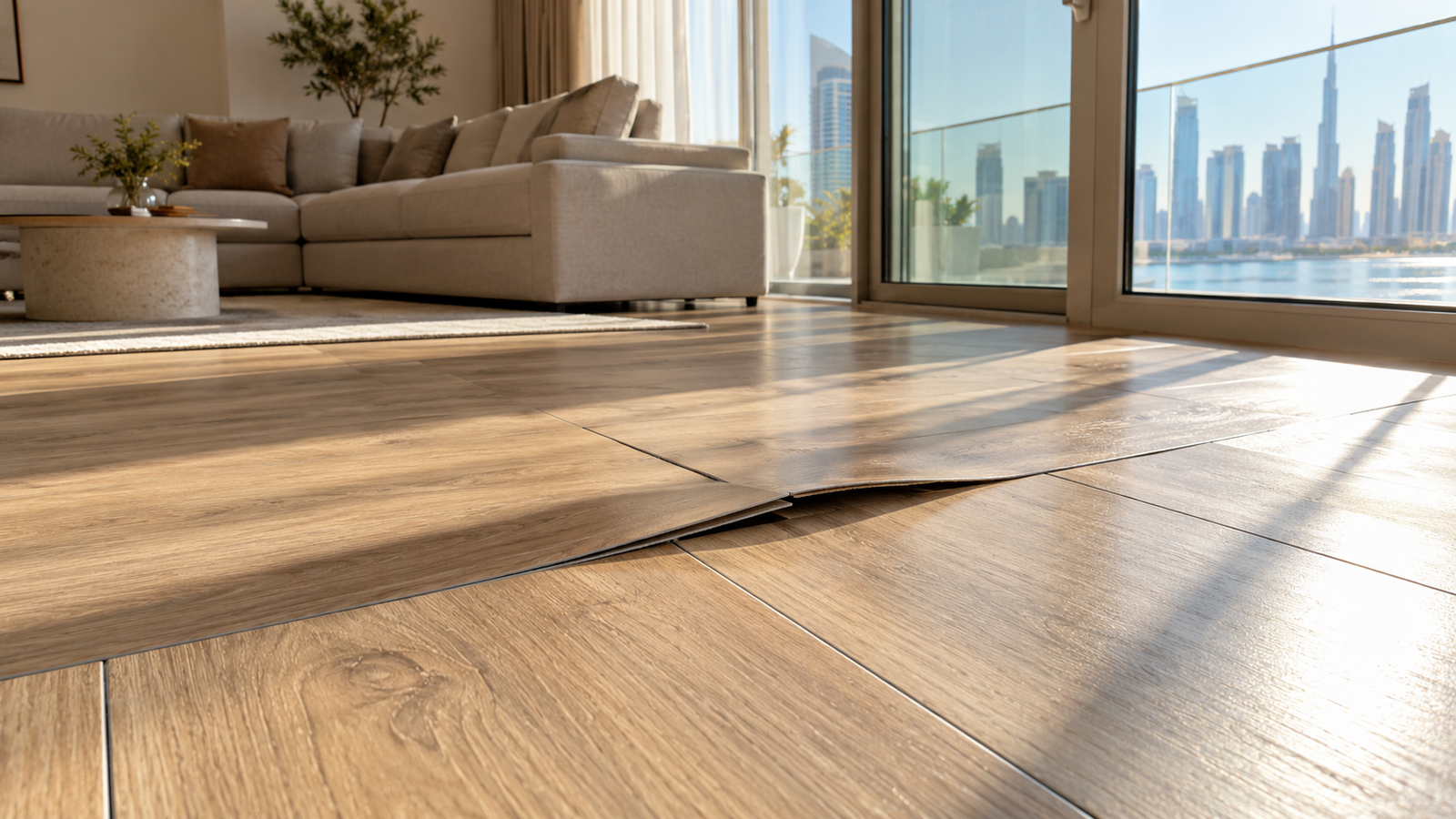
Two planks rise where they meet and form a small ridge, like a tent. This is the classic sign of a floating floor that has expanded and has nowhere to go. The planks push against each other, and the joint lifts.
The surface looks wavy, or a soft bubble appears under the plank. Waves usually appear over a wide area. Bubbles often point to trapped moisture or adhesive that has let go in a small patch.
Planks near a wall or doorway rise and may press against the skirting. This often means the floor has no room to move at the perimeter.
Sometimes one area shows a ridge while another shows gaps between planks. The floor has shifted as a whole, usually because heat expanded it in one place and a heavy item held it back in another.
A hollow sound or a soft feel when you walk over a spot can mean the plank has lifted from the subfloor. Test the area by pressing gently with your hand before you decide how serious the problem is.
Vinyl expands when it gets warm and shrinks when it cools. Every floor does this to a small degree. Problems start when the floor cannot move freely or when an outside force pushes it. Dubai creates several of these conditions at once.
Floor to ceiling glass lets in intense sunlight for many hours. The sun heats the planks directly, and the surface can become much hotter than the air in the room. A heated plank expands. If the area near the glass is hot and the rest of the room is cool, the floor pushes from one zone into another. Our article on flooring that stays cool in summer heat explains how shade, colour and window protection reduce this effect.
Many homes switch between cold air at night and warm air during the day. Some owners also turn the air conditioning off while they travel. The floor then heats up in a closed room and expands. When the cooling returns, it contracts again. A floor with a correct gap handles this movement. A floor without one starts to peak and gap.
Floating vinyl needs a small space around the edges. The manufacturer specifies the size of that gap, so always follow the product instructions. Installers sometimes push planks too close to the wall, or the skirting presses on the floor. Doorframes, pipes and cabinets can also block movement. Any of these can cause buckling in warm weather.
Kitchen islands, built in wardrobes and heavy cabinets should not sit on top of a floating floor. They pin the planks in place. The rest of the floor then pushes against the fixed area, and the weakest point lifts. This is one of the most common installation mistakes.
Water from a leaking pipe, a damp slab or a wet mopping habit can collect under the planks. Vinyl itself does not absorb water, but moisture under the floor can weaken adhesive and cause bubbles. Our guide to waterproof flooring for bathrooms and kitchens explains where moisture risks are highest and how to manage them.
Coastal humidity does not damage vinyl directly, but it can add moisture to a subfloor that is already damp. A closed apartment with no airflow can hold that moisture for weeks. Our article on flooring that resists humidity and desert sand covers the wider picture.
Installers should let planks rest in the room for a day or two before they lay them. This allows the material to match the room temperature. Planks laid straight from a hot warehouse or a cold truck can move after installation.
On a glue down floor, the adhesive may fail if the subfloor was dusty, damp or uneven. A weak bond lets the plank lift. Cracks, bumps and old adhesive on the slab can also stop planks from lying flat.
Many cases are simple enough for a careful owner. Others need a specialist. This table helps you decide before you start.
| Situation | Likely cause | DIY or professional? |
|---|---|---|
| One or two planks peaking near a wall | Missing expansion gap | DIY, if you are comfortable removing skirting |
| Ridge across a doorway | Floor pinned by a threshold | DIY or professional |
| Waves across a large room | Heat and no gap, or moisture | Professional |
| Bubble in one small spot | Local moisture or weak adhesive | Check the cause first, then DIY or professional |
| Buckling after a leak | Water under the floor | Stop the leak, then professional |
| Buckling that keeps returning | Subfloor or installation fault | Professional |
If you plan to reinstall planks yourself, our guide to installing laminate flooring yourself in the UAE shows the same floating floor principles, including gaps and layout, in clear steps.
These steps suit a floating click floor. Always read your manufacturer instructions first, because products differ.
Look at the pattern of the buckling. Check whether it sits near windows, along walls, under heavy furniture or near a bathroom. Ask yourself whether the air conditioning was off, whether there was a leak and whether anything new sits on the floor. This first look saves hours of work. A repair that ignores the cause will fail within months.
If you suspect a leak, fix that first. Turn off the water supply to the suspected pipe and dry the area. Move furniture away from the buckled section. Take care with electrical items near any damp floor. If a large area has been wet, call a professional before you lift anything.
If heat caused the problem, wait until the room cools and the planks relax. Close the blinds and run the air conditioning at a normal temperature for a day. Sometimes a mildly buckled floor flattens by itself once the heat source is removed. If it flattens, you still need to find out why it lifted, because it may happen again.
Use a flat tool to ease the skirting away from the wall. Work slowly so you do not damage the paint or the boards. Then look at the gap between the planks and the wall. If the planks touch the wall, or if the skirting presses on the floor, you have found a likely cause.
Lift one or two planks at the buckled area if the click system allows it. Look for damp patches, mould or a musty smell. A moisture meter gives a clearer reading than your hand. If the slab feels damp, stop and call a professional. Re laying a floor over a wet subfloor wastes time and money.
For a floating floor, the aim is to give the planks room to move. Check the gap along each wall and around doorframes, pipes and fixed cabinets. Where the planks touch a fixed object, an installer can trim the edge of the floor to restore the gap. Do this carefully and follow the manufacturer guidance on gap size. Never nail or screw planks to the subfloor to hold them down, because that creates a worse problem.
Disconnect the planks from the affected area back to a sound section. Check each plank for cracks, damaged click edges or permanent bends. Reconnect the good planks and make sure the joints close fully. Clean any dust from the click edges first, because grit can stop a joint from locking properly.
If a plank has a crack, a kink or a broken click edge, replace it. This is where a spare box from the original batch helps. Colours vary slightly between batches, so a spare box keeps the repair almost invisible. If you have no spare box, ask your supplier for the nearest match.
Refit the skirting so it covers the gap but does not press on the floor. Fix the skirting to the wall, not to the planks. Check that door strips and thresholds allow the floor to move underneath.
Check the area after several hot days and again after a cooler week. If the buckling returns, the cause is still active. At that point, a professional inspection is the safest next step.
Glue down vinyl behaves differently. The adhesive holds the plank to the subfloor, so the floor cannot float or expand freely. Buckling here usually points to a bond failure, moisture or a poor subfloor.
First, find out how large the lifted area is. A small bubble may respond to local repair, while a large lifted zone suggests a wider problem. Second, check for moisture, because water under the floor weakens most adhesives. Third, clean the exposed subfloor and remove loose debris or old glue. Fourth, apply the adhesive that the manufacturer recommends and press the plank down firmly, using weight or a roller as instructed.
Do not use random household glue. The wrong adhesive can stain the plank, trap moisture or fail again within weeks. If the lifted area is large or the plank is damaged, replacement is often better than repair. A specialist can also check whether the original adhesive suited the product and the conditions.
Some damage cannot be reversed. A plank that has creased or kinked will not lie flat again. A cracked click edge will not lock. A plank that has stayed wet may have a damaged core or backing. In each case, replacement is the honest answer.
Replace planks when you see permanent bends, cracked locking edges, a soft or swollen feel or discolouration from moisture. Replace them as well when the same plank lifts again after you refit it. Keep any good planks you remove, because they can serve as spares for later repairs.
Call a specialist when the buckling covers a large area, when you suspect water under the floor or when the damage keeps returning. Also call one when you cannot find the cause or when the floor sits in a rented property where the landlord or building rules apply. A specialist can test moisture, check the subfloor, restore the gaps and replace damaged sections without disturbing the rest of the floor.
If the floor was installed recently, check your warranty first. Many warranties require professional installation and correct subfloor preparation. Our page on professional flooring installation explains what a complete service should include. If you want an experienced team to inspect the problem, you can read about how we work as the best flooring company in Dubai.
Prevention costs far less than repair. A few habits protect your floor through the hottest months.
Daily care also helps. Sweep regularly, mop with a damp cloth and avoid steam mops. Our guide to maintaining vinyl flooring in the Dubai climate covers these habits in detail. A long list of installation errors also appears in our article on flooring mistakes to avoid when renovating in the UAE.
No floor is completely immune to movement. Different constructions handle heat in different ways, so the table below gives a simple comparison.
| Floor type | Heat movement | Moisture behaviour | Note |
|---|---|---|---|
| Flexible click vinyl | Moderate | Plank resists water | Needs correct gap and shade near glass |
| Rigid core (SPC) | Lower | Plank resists water | Dense core moves less, but still needs a gap |
| WPC | Moderate | Plank resists water | Softer core can dent under heavy items |
| Glue down vinyl | Held by adhesive | Adhesive can fail if damp | Needs a dry, flat subfloor |
| Tiles | Very low | Resist water well | Cold underfoot and slower to install |
Rigid core boards stay flatter in many cases because the dense core moves less. Our SPC flooring page explains how this construction works, and the SPC and WPC comparison shows how the two differ. If you want a fixed surface with almost no movement, tiles remain a strong option, and our article on vinyl flooring and tiles in the UAE compares the cost and comfort of both.
Each type of property has its own risks. Looking at yours helps you act early.
Villas often have large glass doors, open plan rooms and long floor runs. Large areas create more expansion, so gaps and doorway breaks matter. South facing living rooms deserve extra shade. Our page on vinyl flooring for villas in Dubai gives background on layouts and thickness levels.
Apartments suffer when owners switch off the air conditioning during travel. Sun through balcony doors can heat the floor in one zone. Neighbour leaks can also reach your slab. We compare both home types in our article on flooring choices for villas and apartments.
Tenants sometimes place heavy furniture without knowing the floor type, and empty units can get very hot. Landlords should leave clear care notes and keep a spare box. Our guide to the best flooring for rental properties in Dubai explains how to protect floors between tenants.
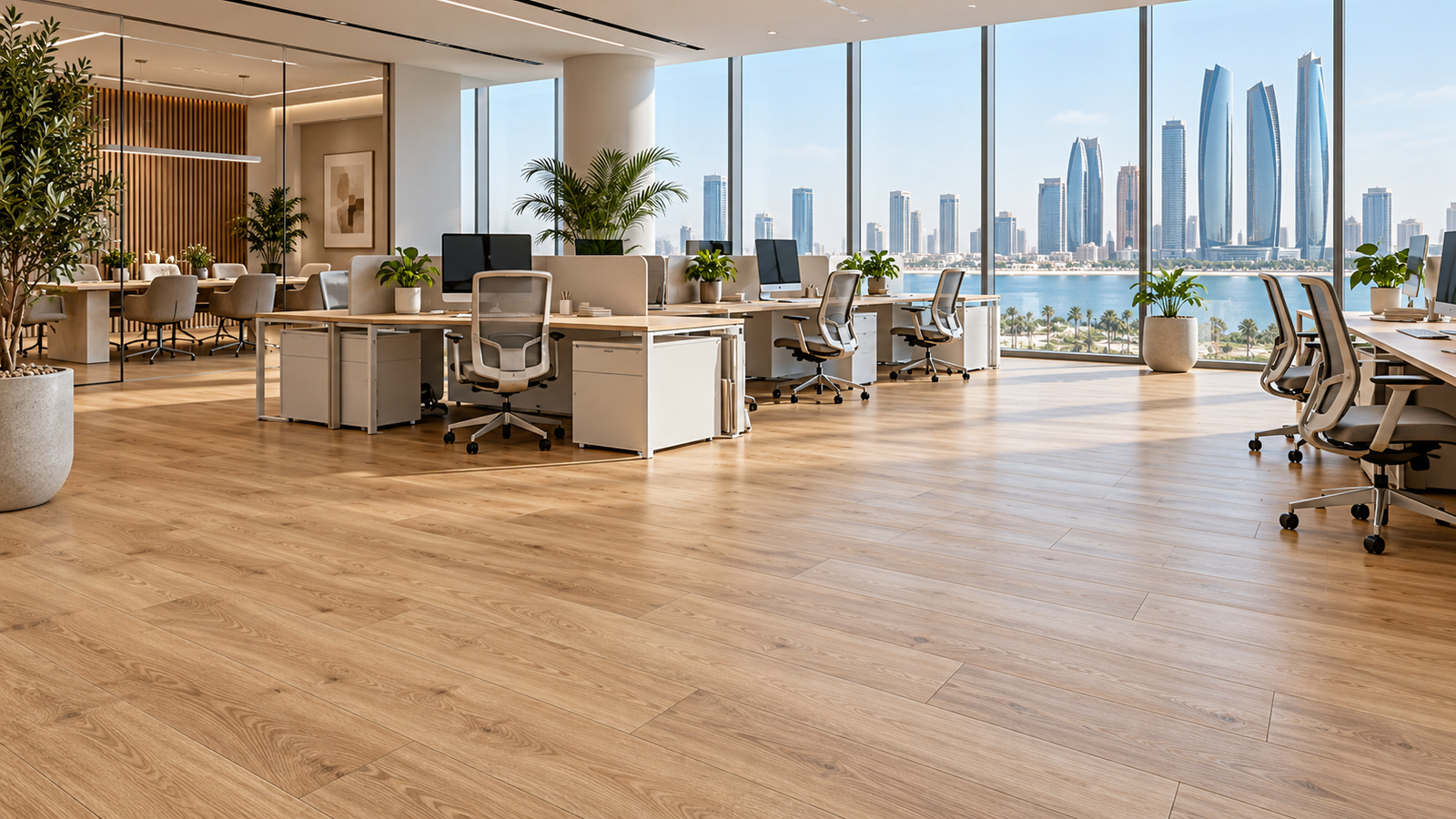
Offices with large glass frontages and heavy desks need correct gaps and sensible furniture placement. Glue down floors often suit these spaces, but they need a dry and flat subfloor. For more ideas, read our article on office flooring solutions in the UAE.
Kitchens and serving areas see spills, steam and hot equipment. Water at the joints and heat near cooking zones can cause lifting. Our guide to the best flooring for restaurants and cafes explains what to ask for in these spaces.
Vinyl is made for indoor use. Direct sun, rain and large temperature swings will cause buckling very quickly outside. If you want a floor for a terrace, read our guide to outdoor decking flooring for Dubai terraces instead.
Repair costs vary because the work varies. A small gap correction near one wall takes far less time than a large area with moisture damage. Several factors shape the final figure.
The cause matters most. Fixing an expansion gap is quicker than drying a slab and replacing planks. The size of the area comes next, since larger zones need more labour and material. The floor type also matters, because glue down repairs need adhesive, preparation and curing time. Finally, access counts. Furniture removal, building rules and lift booking all add time.
Ask for a written, itemised quote after a site visit. It should list inspection, labour, replacement planks, adhesive and any moisture treatment separately. Our flooring cost guide for Dubai shows how to read a quote and spot missing items.
Responsibility depends on the cause. If the installer left no expansion gap or skipped subfloor preparation, the fault usually lies with the installation. If a leak or an owner decision caused the problem, a warranty may not apply. Manufacturers also exclude damage from direct heat, uncontrolled humidity and incorrect use.
Take photos as soon as you notice the problem. Note the date, the room temperature and any recent changes, such as new furniture or a leak. Contact the supplier or installer in writing and ask for an inspection. Keep your invoice and warranty documents safe. Clear records make a claim much easier to assess.
The most common causes are heat, a missing expansion gap and moisture under the floor. Heavy fixtures that pin a floating floor also cause lifting. Look at where the buckling appears, because the location usually points to the cause.
Sometimes. If heat caused the lifting, the planks may relax once the room cools. If the planks are creased, wet or pinned against a wall, they will stay lifted until you fix the cause.
Yes. Direct sunlight through large windows can heat the surface and make the planks expand. A floor with correct gaps handles this movement. A floor without gaps can peak and lift.
Remove the skirting, check the gap around the walls and free any area where the floor touches a fixed object. Refit the planks and make sure the joints lock fully. Replace any plank with a damaged edge.
The correct size depends on the product and the room size. Follow the manufacturer instructions for your floor. A professional installer can measure and adjust the gap for you.
It is not a good idea. Click floors are designed to float, and glue can stop them from moving. The result may be worse buckling nearby. Fix the cause and refit the planks properly.
It depends on the cause and the warranty terms. Installation faults may be covered, while damage from leaks, direct heat or misuse often is not. Read your warranty and contact your supplier with photos.
Shade large windows, keep a steady room temperature and make sure the floor has proper gaps. Avoid heavy fixed items on a floating floor and fix leaks quickly. A professional check before summer can catch problems early.
Not always. Many cases need only gap correction or a few replacement planks. If the buckling covers a large area or returns after repair, the subfloor or the installation may need a full review.
Now that you know how to fix vinyl plank flooring buckling, start with a careful look at the floor. Note where the planks lift, check the gaps near the walls and think about recent leaks or heat. Take clear photos and measure the affected area. If the cause is simple, you can follow the steps above. If it is not, ask a specialist to inspect the floor before the damage spreads. To arrange a site visit, get in touch through the Urban Floors home page.
Category :
Share :
WhatsApp us