
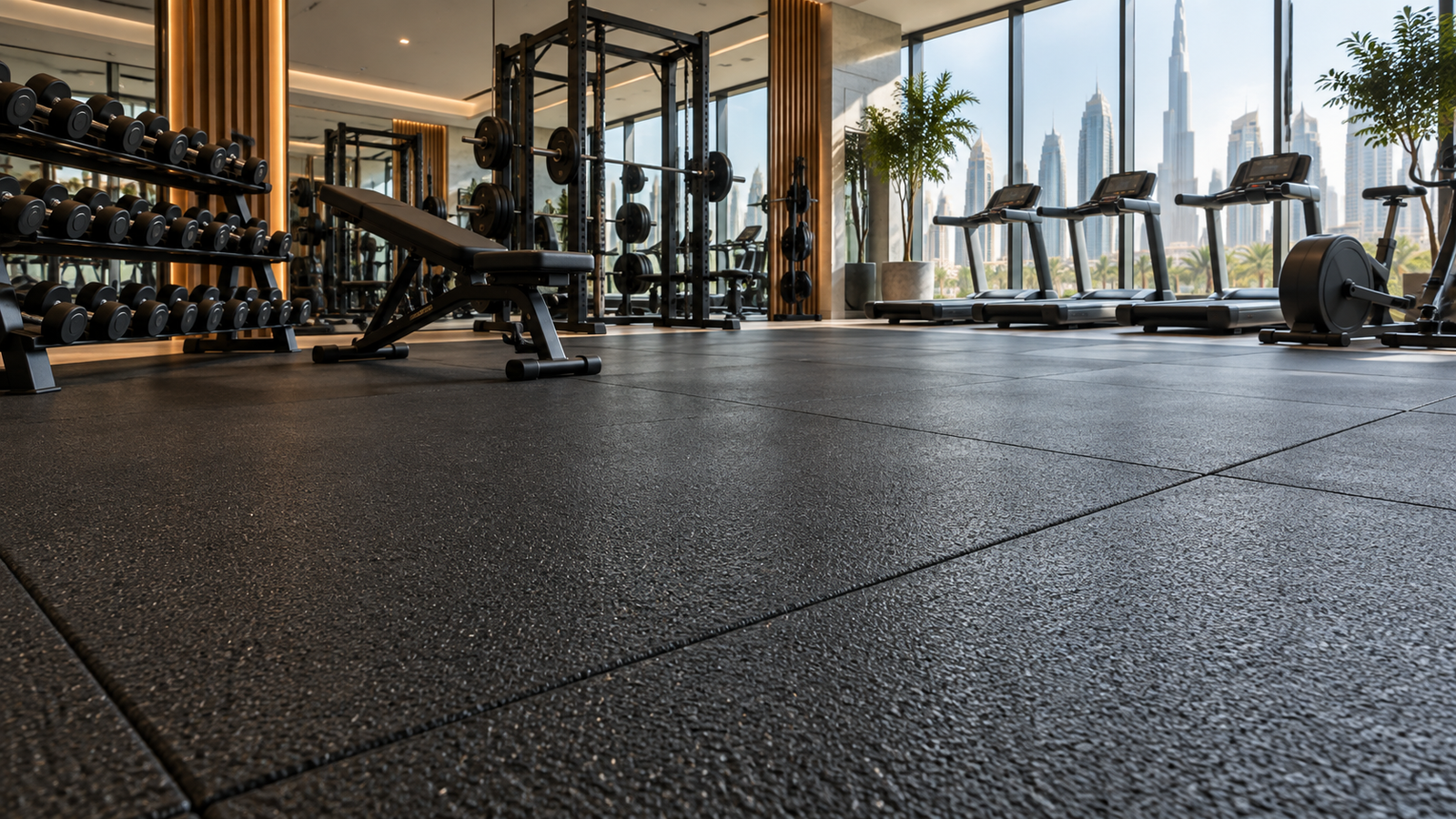
Choosing the right gym flooring Dubai property owners and fitness business operators can rely on involves more than finding a surface that looks professional. The floor needs to support the activities taking place, protect the underlying surface, manage noise and provide a suitable level of grip. A home workout area has different requirements from a commercial gym with heavy weights, treadmills and classes throughout the day.
Dubai also brings practical considerations into the decision. Air conditioning keeps many indoor spaces comfortable, but temperature changes, humidity, dust and cleaning routines can still affect flooring performance. In apartments, sound transfer to neighbouring homes may be a concern. In commercial fitness centres, the floor must cope with repeated foot traffic, equipment movement, sweat and frequent cleaning.
There is no single flooring material that suits every training area. Rubber flooring is often considered for weight zones because of its cushioning and impact protection. Vinyl can be useful in selected exercise and multipurpose rooms, while specialist sports surfaces may be more appropriate for studios that involve repeated movement, stretching or group classes. The best choice depends on the activity, equipment, available space and budget.
This guide compares the main gym flooring materials, explains what affects installation costs, and covers the details to check before buying. It is intended for homeowners setting up a workout corner, landlords preparing a fitness room, and business owners planning a gym or studio in Dubai and across the UAE.
Gym flooring is part of the training environment, not simply a decorative finish. It influences how equipment sits on the floor, how comfortable certain exercises feel and how well the underlying surface is protected from everyday use. Selecting an unsuitable product can lead to unnecessary noise, surface damage, difficult cleaning or a floor that does not suit the intended workout.
A gym may contain several activities within one space. Dumbbell training, weightlifting, treadmill use, stretching and group classes all place different demands on the surface. A floor designed for light exercise may not be suitable beneath heavy weights, while a thick, soft surface can feel unstable for some movements that require firm footing.
For example, a home gym in a spare bedroom may mainly be used for yoga, resistance bands and moderate dumbbell training. A commercial gym in a retail unit may need separate zones for free weights, cardio equipment and functional training. Planning each zone around its actual use helps avoid paying for a specialist surface where it is unnecessary, or installing a basic floor where stronger protection is needed.
Weights can chip tiles, mark timber finishes and damage other hard surfaces if they are dropped or placed directly on them. Equipment may also vibrate during use, particularly treadmills and other motorised machines. A suitable protective layer can help reduce direct contact between the equipment and the underlying floor.
However, not every rubber mat provides the same degree of impact protection. Thickness, density, construction and the type of activity all matter. Heavy lifting requires a different approach from placing a stationary exercise bike on the floor. Check the product guidance and equipment manufacturer’s recommendations before choosing a surface.
A suitable floor can make a workout area more comfortable to use and easier to maintain. The right texture can provide useful grip, while a properly installed surface can help prevent loose edges from becoming trip hazards. Routine cleaning also becomes more manageable when the material suits the amount of sweat, dust and foot traffic the gym receives.
The goal is to choose flooring that supports safe movement and fits the way the room is used. Appearance matters, but it should come after suitability, stability and ease of maintenance.
Rubber gym flooring UAE buyers consider is available in rolls, interlocking tiles and individual mats. These formats can look similar after installation, but they differ in how they are fitted, how joints behave and how easy it is to replace a damaged section. The right format depends on the room dimensions, training intensity and the finish you want.
Rubber tiles are popular in free weight zones because they can provide a protective layer between weights and the subfloor. Individual tiles can also make it easier to replace a damaged section without removing the entire floor. This can be useful in commercial gyms where certain areas receive much heavier use than others.
The thickness and density should be chosen according to the equipment and expected impact. A tile suitable for light dumbbell work may not be appropriate for repeated barbell drops. Ask the supplier what activities the product is designed to support and whether additional impact protection is required beneath lifting platforms.
Interlocking edges may help hold tiles together, but they still need a suitable, level base. Check that the joints fit closely and that the finished surface will not shift during exercise. In busy gyms, movement between tiles can become a maintenance issue if the product or installation method is not suitable for the room.
Rubber rolls can create a more continuous appearance across a larger area, with fewer visible joints than individual tiles. This can be useful in training studios, cardio zones and spaces where a consistent surface is preferred. Roll flooring also offers different thicknesses and finishes, so product specifications still need to be reviewed.
The base must be prepared properly, and the installation may require a suitable adhesive or another fixing system recommended by the manufacturer. Seams and edges should be finished neatly to reduce the chance of lifting. Ask whether the product is intended for loose laying or permanent installation, and confirm how it should be cleaned.
For a compact home gym, individual mats may be enough to protect the floor beneath a stationary bike, bench or small collection of weights. They can be convenient when you do not want to renovate the entire room. However, small mats do not necessarily provide stable coverage for a whole workout area.
Measure the footprint of your equipment and leave sufficient space for movement around it. If you use dumbbells, a bench and resistance equipment together, consider whether the mats cover the full working zone rather than just the equipment feet. For a permanent gym room, a continuous installation may be more practical.
Home gym flooring Dubai residents need depends on where the workout area is located and how the room will be used. A converted bedroom, a garage, a villa basement and a spare room in an apartment all have different conditions. Before buying material, consider the existing floor, the equipment weight, the available ventilation and any building restrictions.
Apartment gyms are often compact, so the flooring needs to fit around furniture, storage and exercise equipment. Rubber mats can be suitable for a small workout zone, while a larger dedicated room may benefit from a fitted floor. The key is to avoid creating raised edges or unstable joints in the area where you exercise.
Noise is also worth considering. Dropping weights, jumping and using a treadmill can transmit vibration through the structure, even when the floor is covered with rubber. Flooring may help reduce some impact noise, but it cannot guarantee soundproofing. If you live in an apartment, check building rules and choose exercise times and equipment with neighbours in mind.
A home gym may also sit on top of existing tile or another finished surface. Confirm that the product is suitable for this base and that the floor is clean, level and stable. If you plan to remove the flooring later, ask whether the installation method could leave adhesive residue or marks.
Villas often offer more space for strength training, cardio machines and functional exercise. A garage conversion may provide room for larger equipment, but the condition of the concrete base should be assessed before installation. Dust, moisture, uneven areas and vehicle related residue may affect whether the surface is ready for flooring.
If the room is exposed to strong temperature changes or occasional moisture, check the product’s approved installation conditions. Do not assume that a material suitable for an air conditioned bedroom will perform equally well in an unconditioned garage. Ask about ventilation, moisture testing and any required preparation.
For a multi purpose room, choose a floor that can cope with the planned training while remaining comfortable for stretching and bodyweight exercises. The best solution may involve separate zones rather than covering the entire room with one material.
Renters may prefer a removable mat system rather than permanent adhesive installation. This can help protect the existing floor while keeping future changes simpler. Even so, mats should sit flat and should not trap moisture or leave marks on sensitive finishes.
Check the tenancy agreement before making alterations. If the gym equipment is heavy, confirm that the existing floor and room are suitable for the load. Keep equipment away from doorways and ensure there is enough clearance for safe movement. A practical setup should protect the property as well as support the exercise routine.
Commercial gym flooring Dubai operators select must account for repeated use, different training styles and the time available for cleaning and maintenance. A fitness centre may be open for long hours, with members moving between machines, lifting areas and classes. The flooring should be selected around the most demanding activities rather than the lightest use in the building.
Free weight areas usually need strong impact protection, particularly where dumbbells and weight plates are regularly placed on the floor. The product should suit the expected weights and training practices. If the gym allows barbell drops, ask whether a dedicated lifting platform or a specialised impact system is required.
Equipment layout is just as important as the flooring material. Leave sufficient space around benches and racks, and ensure that people can move without crossing through active lifting zones. Marked training areas can help organise the space and make the floor easier for members to understand.
Treadmills, bikes, rowing machines and cross trainers need stable, level support. Some machines also create vibration, so follow the equipment manufacturer’s instructions about installation and protective mats. A softer surface is not always better because equipment can rock or sit unevenly if the floor compresses too much.
Functional training and group classes may involve repeated foot movement, quick changes of direction and floor exercises. A surface that works well under heavy weights may not provide the same comfort or traction for these activities. In a multi use facility, consider separate flooring zones with clearly finished transitions.
Not every part of a commercial gym needs heavy duty rubber. Reception areas, corridors and offices may use different flooring depending on foot traffic, cleaning requirements and the appearance of the business. A coordinated design can still be achieved by using suitable materials for each space.
Areas exposed to wet shoes or frequent cleaning need particular care. Choose products designed for those conditions and avoid assuming that a gym floor is automatically suitable for shower rooms. For other commercial environments, this overview of office flooring solutions in the UAE offers a useful comparison of how flooring requirements change between work areas.
Before opening a new facility, plan how the flooring will affect maintenance access, equipment installation and future repairs. A well designed gym should be straightforward to clean and should allow worn or damaged areas to be addressed without unnecessary disruption.
Rubber is often a strong candidate for exercise areas, but it is not the only choice. Vinyl, laminate and other hard surface products may suit parts of a fitness facility, particularly where heavy impact is not expected. The important distinction is between a decorative floor and a floor designed to support a specific exercise activity.
Rubber is commonly considered for weight zones because it can provide cushioning and help protect the subfloor. Vinyl is available in many colours and finishes and may be suitable for selected light exercise spaces, multipurpose rooms or areas that need a different visual style. However, ordinary decorative vinyl should not be treated as equivalent to specialist gym flooring.
Check the intended use, surface stability, wear rating and cleaning instructions for each product. If you plan to place heavy equipment on vinyl, confirm that the product can tolerate the concentrated load and that the equipment feet will not cause indentation. For a more general overview of vinyl flooring options, compare the specific product features with the needs of your training area.
Stone plastic composite, commonly known as SPC, is a rigid core flooring category used in residential and commercial interiors. It can work in certain rooms where the main requirement is a hard wearing decorative surface, but it is not automatically a replacement for rubber in a weightlifting zone.
Heavy weights, repeated impact and equipment vibration can place demands on a floor that a standard rigid core product was not designed to handle. If you are considering SPC for a fitness room, check the permitted uses and the equipment manufacturer’s requirements. Explore SPC flooring products for general product information, then ask whether the selected option is appropriate for the intended activity.
Laminate is usually chosen for its wood inspired appearance and use in living spaces, offices and other suitable interiors. It may be appropriate for a room used for gentle movement or stretching if the product and base meet the relevant requirements. However, it is not the first material to assume will withstand dropped weights, concentrated equipment loads or repeated high impact exercise.
If you want a room that doubles as a home office and a light exercise area, think about the most demanding activity that will take place there. You may need protective mats beneath equipment, or a separate exercise zone with a more suitable material.
| Material | Potential use | Main point to check |
|---|---|---|
| Rubber tiles | Weight zones and general gym areas | Thickness, density and impact suitability |
| Rubber rolls | Larger training spaces and selected studios | Seam quality, fixing method and subfloor |
| Individual rubber mats | Compact home workout areas | Coverage, movement and edge stability |
| Vinyl | Selected light exercise or multipurpose rooms | Load suitability and resistance to indentation |
| SPC | Suitable decorative areas with limited impact | Product guidance and equipment compatibility |
| Laminate | Selected low impact multipurpose spaces | Surface protection and suitability for exercise |
The table is a starting point rather than a substitute for product specifications. Ask the supplier to confirm the suitability of the exact product for the activity you plan to carry out.
Gym flooring Dubai price depends on more than the size of the room. Two projects with identical measurements can have different totals because they use different materials, require different levels of preparation or include different finishing work. A useful quotation should explain what you are paying for rather than presenting one unexplained total.
Rubber tiles, rolls and individual mats have different construction and installation requirements. Thickness is an important factor, but thicker does not automatically mean better for every activity. The product needs the right balance of density, stability and impact protection for the equipment and exercise style.
For example, a small home gym used for stationary cycling and moderate dumbbell workouts may not need the same floor system as a commercial lifting area. Paying for a heavy duty product across an entire room can be unnecessary if only one zone needs that level of protection. Conversely, choosing a light mat beneath heavy equipment may not provide enough protection.
An existing floor may need cleaning, levelling, repair or removal before the new surface can be installed. Concrete bases may have cracks, dips or moisture concerns that need to be assessed. Existing tiles may have uneven joints, loose sections or contamination that affects adhesion.
Ask whether the quotation includes site inspection and preparation. If old flooring needs to be removed, confirm who will handle disposal and whether any repairs to the base are included. These details can have a significant effect on the final cost.
A simple rectangular room is usually easier to measure and plan than a space with multiple corners, columns, doorways and built in furniture. Cutting and finishing around obstacles can increase installation time. The method used to secure edges and join tiles or rolls also affects the final result.
For an accurate estimate, share room measurements, photographs and information about the equipment. A site visit is useful for checking the base and identifying issues that may not be visible in photographs. The flooring cost guide for Dubai can help you understand common project considerations, but a supplier needs the details of your particular room to provide a meaningful quote.
When comparing suppliers, check that each quote covers the same scope of work. One may include material only, while another includes preparation, installation, edge finishing and delivery. Confirm the product specification, coverage area, estimated schedule and any exclusions before approving the project.
Avoid choosing solely on the lowest price. A product that is unsuitable for the equipment or difficult to maintain may cost more in repairs and replacement over time. A clear quotation helps you balance initial spending with the practical needs of the gym.
Gym flooring installation Dubai projects benefit from proper planning because the finished surface must remain stable under movement and equipment loads. Preparation also reduces the risk of raised edges, open seams or problems caused by an unsuitable base. The exact installation method depends on the product and the manufacturer’s instructions.
Start by measuring the full space, including recesses, columns and areas around fixed equipment. Identify the location of doors, power outlets, drains and other features that could affect the layout. If the gym will have several training zones, mark these on a simple plan before ordering material.
The base should be checked for flatness, cleanliness and moisture conditions. A floor covering can hide minor visual imperfections, but it will not correct an unsuitable subfloor. If the room has a history of leaks or dampness, investigate the cause before installing new material.
Some rubber tiles are designed to interlock, while other products require adhesive or a different fixing system. Rolls may need specialist cutting and seam treatment. Loose laid mats can be practical in small areas but may shift if the base, mat design or equipment layout is unsuitable.
Follow the manufacturer’s requirements instead of assuming that one method works for every product. Adhesive selection, curing time and room conditions can affect installation quality. Where heavy equipment is involved, confirm when it can be positioned on the new floor and whether any additional protective layers are needed.
It is easier to plan the floor before racks, benches and cardio machines are moved into place. Confirm the dimensions and approximate positions of heavy equipment, allowing enough room for safe use and access for maintenance. Avoid putting seams or loose edges in locations where people regularly pivot or move equipment.
If you are renovating a commercial gym, ask the installer how the work will be divided into stages and whether the facility must close during installation. A phased plan may be possible, but it depends on the product, access and the safety of the remaining open areas.
A professional installer should explain the preparation requirements, confirm the selected product and identify any limits on its use. The quotation should set out the work included and describe any exclusions. You should also receive instructions on cleaning, furniture or equipment placement, and the appropriate response to spills or damage.
Discuss your project with a provider experienced in professional flooring installation. Clear communication before work begins helps reduce uncertainty about the finished surface and the time needed before the gym can be used.
A gym floor collects more than ordinary household dust. Sweat, shoe marks, fine sand, spilled drinks and cleaning products can all affect the surface. A practical maintenance routine protects the appearance of the floor and helps keep the workout area comfortable to use.
In a busy fitness centre, visible spills should be cleaned promptly and shared equipment areas should be checked regularly. Use cleaning products approved for the flooring material, and follow the recommended dilution and contact time. Strong chemicals can affect some rubber compounds, adhesives or surface finishes, so avoid choosing a cleaner simply because it is labelled for commercial use.
Dry removal of dust and grit should be part of the routine. Fine particles can accumulate around equipment feet, under benches and along wall edges. If these areas are difficult to access, make sure the layout leaves enough room for routine cleaning.
For rubber floors, check the supplier’s guidance about odour, ventilation and cleaning. Some products may have a noticeable smell when new, and the appropriate ventilation period depends on the material and installation conditions. Do not cover the floor or move heavy equipment onto it before the supplier says it is ready.
Sweat and water can make some surfaces slippery, especially if they remain on the floor during exercise. Wipe spills promptly and use appropriate cleaning methods after group sessions or intensive training. The surface should be suitable for the movements performed there, and users should have a clear route around wet areas.
If a gym includes showers or changing rooms, do not automatically continue the same flooring into those spaces. Wet areas require products designed for their moisture exposure and slip resistance needs. Review water resistant flooring options when planning adjoining areas, and confirm suitability for the specific wet environment.
Dubai’s fine dust can enter through entrances, windows and clothing, even in air conditioned buildings. Entrance mats and regular cleaning can reduce the amount of grit that reaches the training floor. Avoid using excessive water during cleaning, especially where moisture could reach seams or the subfloor.
Indoor temperature and humidity conditions should also follow the flooring manufacturer’s recommendations. If the gym is in a garage, basement or other space with less consistent air conditioning, check whether the selected product is suitable for those conditions. This guide to flooring for UAE humidity and sand explains why local environmental factors should be part of material selection.
Check seams, tile edges and high traffic areas regularly. A loose edge can create a trip risk, while a damaged tile may allow further wear or movement. Repair the problem according to the manufacturer’s instructions rather than covering it with tape or an improvised patch that may lift during exercise.
Keep a record of the product name and specification so replacement material can be matched if needed. This is particularly helpful for commercial facilities, where different areas may be installed at different times. A simple inspection routine can help identify small problems before they disrupt the gym.
The best gym flooring supplier Dubai customers can work with should understand both the material and the intended training activity. A supplier who mainly handles decorative flooring may not be the right choice for a facility with heavy lifting, specialist training equipment or strict maintenance requirements. Ask questions that reveal whether the recommendation is based on your actual use.
Request the product specification, available thicknesses, surface finish, installation method and maintenance guidance. Ask what types of equipment and exercise activities the product is intended to support. If you plan to use heavy weights, explain whether weights will simply be placed on the floor or may be dropped during training.
Samples can help you compare texture and colour, but they do not prove that the material is suitable for every application. A supplier should be able to explain the intended use and any limitations. Ask whether the product is suitable for the room’s base and indoor conditions.
A good quotation should distinguish the material cost from preparation, installation and finishing. It should also explain how the installer will handle seams, edges, columns and doorways. Confirm whether delivery, waste removal and any necessary floor repairs are included.
For a commercial gym, ask how the work will affect access and operating hours. For a home gym, confirm how furniture and equipment should be moved and when the room can be used after installation. These practical details are part of the service, not minor extras.
Ask whether the supplier has completed projects with a similar type of use. A small home workout room and a large strength training facility have different requirements, so relevant experience is more useful than a general claim of expertise. If examples are available, look at the edges, transitions and joints as well as the overall appearance.
Also ask what support is available if a tile becomes damaged or a seam begins to lift. Understand the product’s care requirements and keep the purchase documentation. You can use this guide to finding the best flooring company in Dubai as a starting point when comparing providers.
One frequent mistake is choosing the floor by thickness alone. A thick product may still be unsuitable if its density or construction does not match the equipment and activity. Another is assuming that every rubber floor is designed for dropped weights, or that every product sold for gyms offers the same impact protection.
It is also easy to overlook the existing subfloor. Uneven tiles, moisture problems or loose sections can affect the new installation even when the top surface looks attractive. Before signing off on the project, review these flooring mistakes to avoid and ask the installer to explain how your project will address the relevant risks.
Gym flooring cost depends on the material, thickness, room size, subfloor condition and installation method. Ask for a quotation that separates the flooring product from preparation and labour, and confirm whether delivery, finishing and removal of old material are included.
Rubber mats or tiles are often worth considering for home gyms that use weights or exercise equipment. The best option depends on the type of training, the existing floor and whether the space is an apartment room, villa garage or dedicated gym.
Rubber flooring can be suitable for weight training when its construction and thickness are designed for the expected impact. For repeated barbell drops or very heavy lifting, ask whether a dedicated platform or additional impact protection is needed.
Some gym flooring systems can be placed over existing tiles if the base is stable, clean and sufficiently level. Check the product instructions first, because uneven joints, loose tiles and moisture problems may need to be addressed before installation.
There is no single thickness that works for every gym. The correct choice depends on the equipment, the expected impact, the floor beneath it and the manufacturer’s recommendations, so describe your planned workouts before choosing a product.
Some products are suitable for air conditioned indoor spaces, while others may have specific limits on temperature, moisture or installation conditions. If the gym is in a garage or another area without consistent climate control, confirm suitability with the supplier before purchasing.
The schedule depends on the area, the product, preparation requirements and the installation method. A simple mat setup may be quick, while a larger fitted floor may need subfloor repairs, adhesive curing or staged work before the equipment can be used.
Suitable flooring may help reduce some impact noise and vibration, but it cannot guarantee soundproofing. Heavy weights and treadmills can transmit sound through the building structure, so consider equipment mats, careful placement and building rules as well as the floor covering.
Remove loose dust and grit regularly, wipe spills promptly and use a cleaner approved for the product. Follow the manufacturer’s instructions about water, chemical products and drying, especially in areas where people train barefoot or perform floor exercises.
Look for a supplier who asks about your training activities, checks the subfloor and provides clear product specifications and an itemised quotation. Ask about installation experience, maintenance requirements and replacement options rather than relying only on the quoted price.
A good gym floor should suit the training, the building and the people who use it. A homeowner setting up a few weights and a treadmill may need a simple protective area, while a commercial fitness centre may need several different surfaces for strength training, cardio and group exercise. Choosing one material for every zone is not always the most practical solution.
Start by listing the equipment you plan to use and the activities that will take place in the room. Measure the space, check the condition of the existing floor and identify any concerns about noise, moisture or ventilation. For a gym inside a Dubai apartment or villa, consider how the flooring will fit with the rest of the interior and whether the installation needs to be removable.
If you are considering rigid core flooring for a lighter use area, review the differences between SPC and WPC flooring before selecting a product. For a room that serves several purposes, compare the needs of the workout area with the rest of the space. Advice on flooring that stays comfortable in Dubai heat may also help when evaluating adjoining indoor areas, although suitability for exercise must be checked separately.
For landlords preparing a property with a compact workout room, maintenance and replacement options may matter as much as the initial appearance. This overview of flooring for rental properties can help you consider the wider needs of a rental interior.
When comparing materials for lighter exercise spaces, you can also examine vinyl flooring and tile costs to understand the trade offs between different interior surfaces. Remember that decorative flooring is not automatically suitable for heavy lifting or high impact training.
For a project specific recommendation, share the room dimensions, photographs of the existing floor and a list of the equipment you plan to install. Ask for a clear quotation that covers the product, preparation, installation and aftercare. Urban Floors can help you explore suitable flooring options for your project and identify the next steps for planning your space.
Category :
Share :
WhatsApp us