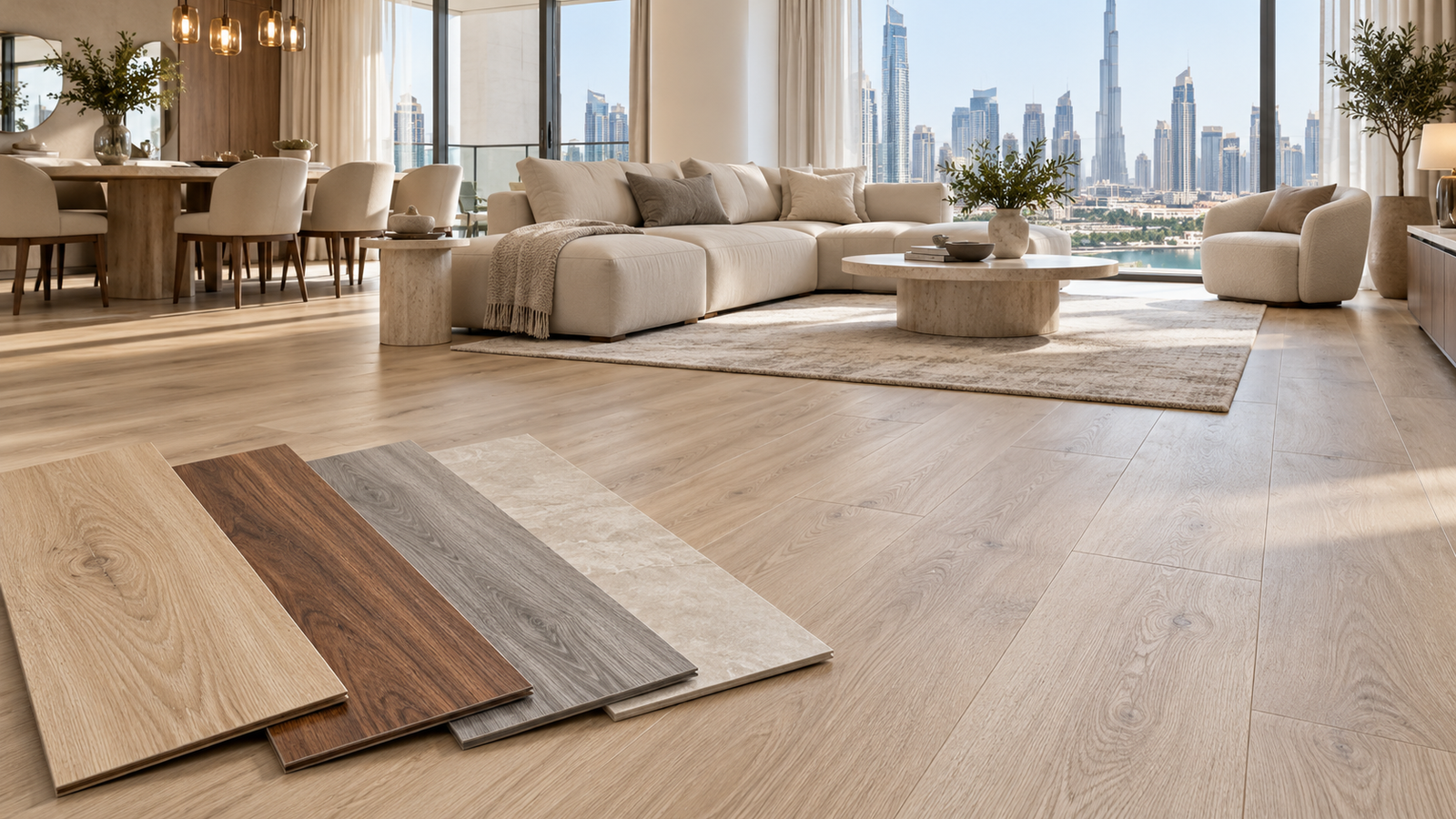
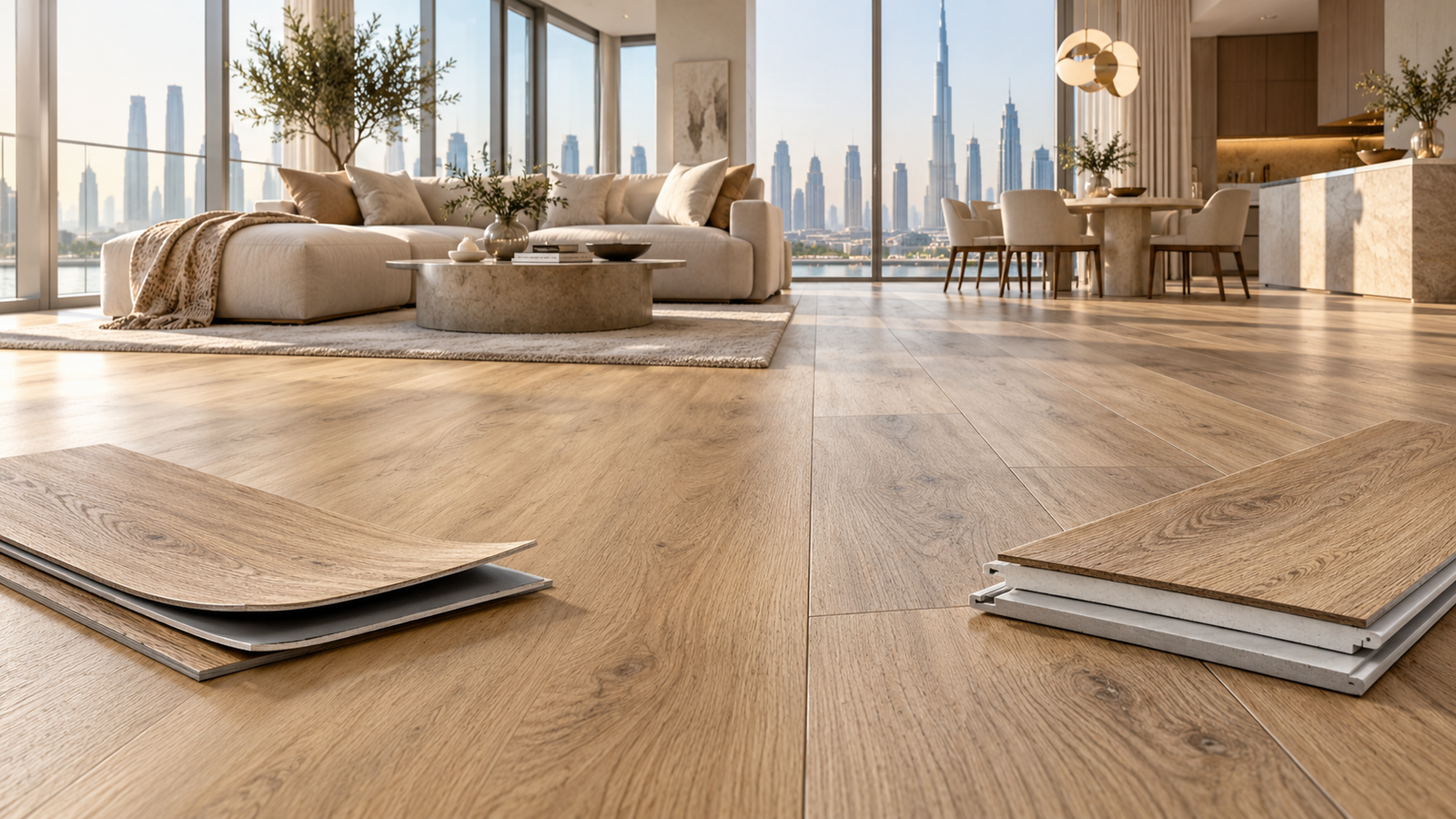
Choosing new flooring for your home involves more than selecting a colour or finish. The material must feel comfortable underfoot, suit your interior design, withstand daily use, and perform well in the local climate. When comparing LVT vs SPC flooring, both options offer attractive wood and stone designs, straightforward maintenance, and practical alternatives to traditional flooring materials. However, their construction makes them perform differently.
For homeowners in Dubai, Abu Dhabi, Sharjah, and other parts of the UAE, the decision often comes down to comfort, durability, temperature exposure, installation requirements, and budget. Luxury Vinyl Tile (LVT) is known for its flexible construction and comfortable feel, while Stone Plastic Composite (SPC) flooring has a rigid core designed to provide greater dimensional stability and resistance to indentation.
Neither option is automatically the best for every property. A bedroom, a busy family living room, a rental apartment, and a commercial reception area can have very different flooring requirements. Understanding how each product works will help you choose a floor that suits your property and daily routine.
Luxury Vinyl Tile, commonly called LVT, is a multi layer vinyl flooring product designed to reproduce the appearance of natural materials such as oak, walnut, marble, and stone. It is available in different plank and tile formats, allowing homeowners to create a wide range of interior styles.
Traditional flexible LVT usually contains several layers. These include a backing layer, a vinyl core, a printed decorative layer, and a transparent protective wear layer. Some products also include additional backing or acoustic features. The exact construction depends on the manufacturer and product range.
One of the main advantages of LVT is its flexibility. Unlike a rigid board, flexible LVT can conform more closely to the prepared surface underneath it. This makes careful subfloor preparation essential because small bumps, dips, or imperfections may become visible through the finished flooring.
LVT is available in glue down and click installation formats. Glue down LVT is bonded directly to a properly prepared subfloor, while click LVT uses a joining system between planks. These formats should not be treated as identical because their installation requirements and performance can differ.
Homeowners considering this material can explore the available vinyl flooring and LVT options to understand the different styles and formats available for residential interiors.
SPC stands for Stone Plastic Composite, also known as Stone Polymer Composite in parts of the flooring industry. It is a rigid core vinyl flooring product that typically combines limestone powder, PVC, and stabilising additives to create a dense core.
Like LVT, SPC flooring can reproduce natural wood and stone designs. Its decorative layer provides the visible finish, while a protective wear layer helps guard against everyday surface damage. Many SPC products also include an attached underlay, although this depends on the product specification.
The main difference is the rigid core. SPC planks maintain their shape more effectively under normal use than traditional flexible LVT. Their rigidity can also make them more suitable for renovation projects where the existing floor is sound and sufficiently level.
SPC is commonly available with a click locking system, allowing planks to connect and form a floating floor. This can reduce the need for adhesive and make installation faster than some traditional flooring methods.
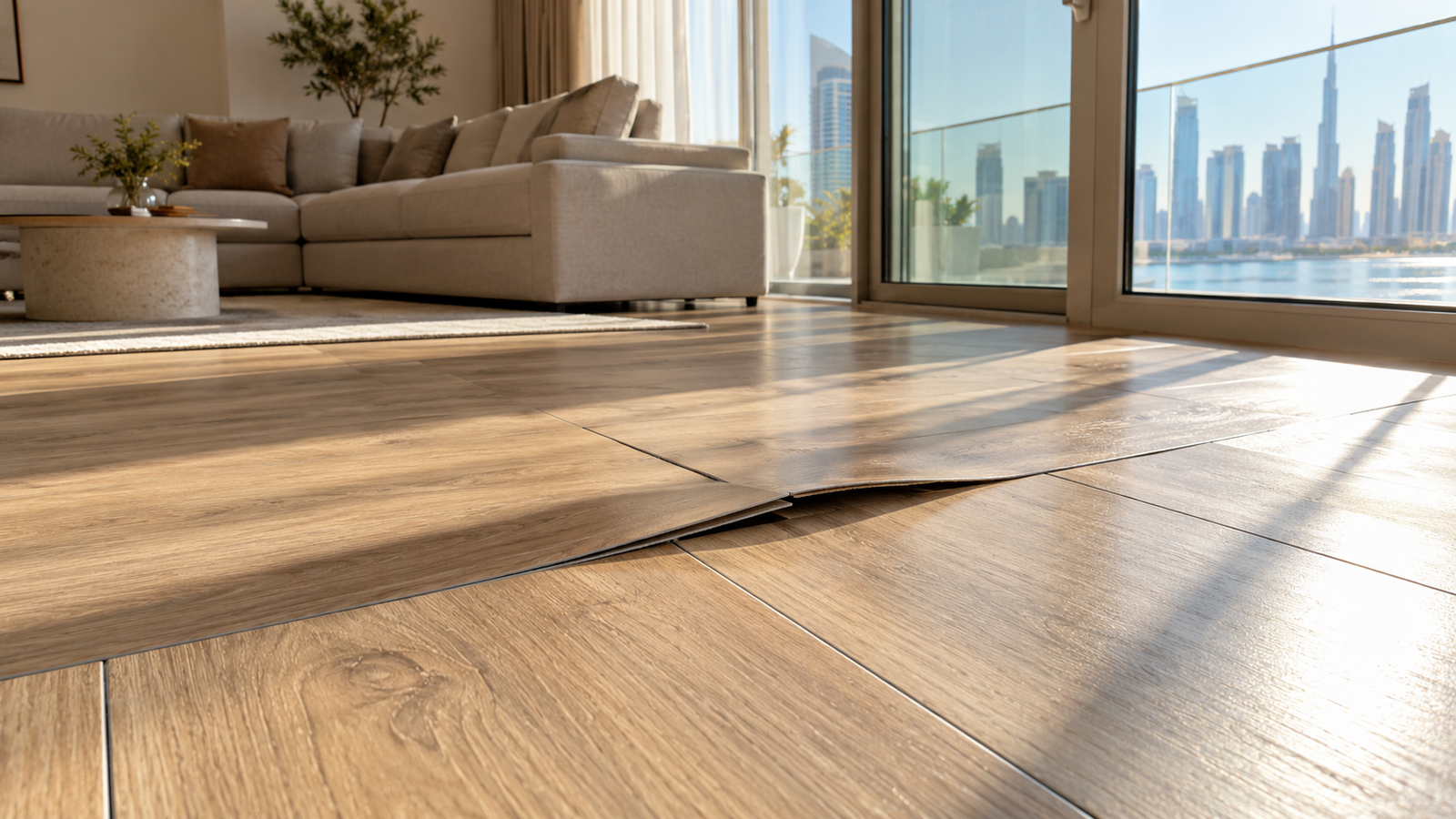
However, SPC is not designed to hide every subfloor problem. Loose tiles, significant dips, raised grout lines, and uneven surfaces may still require correction before installation.
To understand the material in more detail, review the available SPC flooring options and compare the product construction, thickness, surface finish, and installation requirements.
Both products can provide attractive, practical flooring, but their construction influences comfort, installation, and performance.
| Feature | Traditional flexible LVT | SPC flooring |
|---|---|---|
| Core construction | Flexible vinyl | Rigid stone composite |
| Feel underfoot | Generally softer | Generally firmer |
| Installation | Often glue down, also available in click formats | Commonly click lock |
| Subfloor preparation | Requires a very smooth, well prepared surface | Requires a sound, level surface |
| Resistance to indentation | Depends on product construction and wear layer | Rigid core generally offers better indentation resistance |
| Water resistance | Depends on product and installation | Core is generally waterproof |
| Temperature stability | More sensitive to temperature changes | Generally more dimensionally stable |
| Design options | Wood, stone, tile, and decorative patterns | Wood, stone, tile, and decorative patterns |
| Best suited to | Prepared floors where comfort or a slim profile matters | Many residential renovations and busy areas |
| Maintenance | Simple routine cleaning | Simple routine cleaning |
The right choice depends on the exact product rather than its category name alone. Wear layer thickness, manufacturer guidance, installation quality, and the conditions in each room all affect long term performance.
Durability is an important consideration for households with children, pets, frequent visitors, or heavy furniture. Both LVT and SPC can provide a durable surface when the product is selected correctly and installed according to the manufacturer’s instructions.
The wear layer plays a significant role in protecting the decorative surface against everyday scuffs and abrasion. A thicker wear layer can be beneficial in demanding environments, but it does not make a product immune to scratches, dents, or damage.
SPC has an advantage when resistance to indentation is a priority. Its dense, rigid core generally handles concentrated loads better than many flexible LVT products. This can be useful under furniture and in areas with regular foot traffic.
Flexible LVT remains a practical option for homes and commercial interiors, particularly when the subfloor is properly prepared and the product has a suitable wear layer. However, heavy furniture and small concentrated loads can affect flexible products depending on their construction.
Furniture pads, entrance mats, regular dust removal, and careful handling of heavy items help protect both materials.
For properties where durability is a major concern, compare the available flooring installation services and ask about product specifications before making a final decision.
Water resistance is another important factor when comparing LVT vs SPC flooring for UAE homes. Kitchens, laundry areas, entrance spaces, and bathrooms can experience splashes, spills, and regular cleaning.
SPC flooring generally has a waterproof rigid core. This means the core itself does not swell in the same way that moisture sensitive wood based materials can. Many LVT products also offer strong water resistance, and some are marketed as waterproof. Buyers should check the precise product specification instead of assuming every LVT product has the same performance.
There is an important distinction between a waterproof plank and a waterproof floor installation. Water can still pass through perimeter gaps, joints, transitions, or poorly sealed edges and reach the subfloor. This matters particularly in rooms with frequent water exposure.
Neither product should automatically be treated as a complete waterproofing system for a shower or a continuously wet area. The suitability of vinyl flooring in bathrooms depends on the specific product, installation method, room design, and manufacturer’s approval.
For kitchens and other areas where spills are common, SPC can be a sensible choice because of its rigid waterproof core. If you are planning a moisture exposed renovation, review the considerations in this guide to waterproof flooring for Dubai bathrooms and kitchens.
A floor can look excellent and still feel uncomfortable if it does not suit the room. Comfort is particularly relevant in bedrooms, family living rooms, and areas where people spend long periods standing or walking.
Traditional flexible LVT generally has a softer feel underfoot because its construction can flex slightly. This may make it appealing in bedrooms, lounges, and other spaces where comfort is a priority.
SPC has a dense, rigid core, so it normally feels firmer. Some products include an attached underlay that can improve acoustic performance and the feel of the finished floor. However, an underlay should only be used when it is approved for the particular flooring system. An unsuitable underlay can affect the locking joints or product warranty.
Sound performance also depends on the subfloor, the building structure, the installation method, and the underlay. Neither material guarantees complete soundproofing between apartments.
If a quiet, comfortable floor is your priority, compare samples in person and check whether the proposed product includes an acoustic backing. The softest product is not necessarily the most durable, and the thickest product is not necessarily the quietest.
The UAE climate makes flooring selection especially important. Outdoor temperatures can become very high during summer, while indoor spaces rely heavily on air conditioning. Rooms near large windows, balcony doors, and sun exposed areas may experience greater temperature fluctuations than shaded interiors.
SPC flooring generally provides better dimensional stability than traditional flexible LVT because of its rigid composite core. This can make it a useful option for homes where temperature variation is a concern.
Flexible LVT can also perform well in suitable conditions, but its expansion, contraction, and adhesive performance depend on the product, installation method, subfloor, and temperature conditions. A properly installed product in a controlled interior is different from one exposed to intense direct sunlight.
No vinyl flooring should be assumed suitable for unrestricted exposure to extreme heat. Large windows, enclosed balconies, sunrooms, and areas that may become very hot while a property is unoccupied need special attention. Follow the manufacturer’s temperature limits, expansion requirements, and installation instructions.
Humidity is another consideration, especially in coastal locations and rooms where condensation or moisture may occur. Both vinyl options can be practical, but moisture must be managed at the subfloor and perimeter rather than relying only on the surface material.
For more climate related guidance, read about flooring that handles UAE humidity and desert sand and flooring for Dubai summer heat.
Installation is one of the biggest practical differences between traditional LVT and SPC flooring.
Flexible glue down LVT usually requires a smooth, clean, dry, and properly levelled subfloor. Because the material follows the surface beneath it, small imperfections can become visible over time. The installer may need to fill joints, smooth rough areas, and prepare the surface before applying the recommended adhesive.
The advantage is that glue down LVT can provide a slim finished profile. This can be useful when floor height is limited or when a design requires a bonded finish. It may also suit certain commercial projects where a fixed floor is preferred.
SPC commonly uses a click locking system. Planks connect to one another and sit over the prepared subfloor as a floating floor. Depending on the product and the condition of the existing surface, this can make installation over suitable existing tiles possible without removing them.
However, SPC is not a substitute for levelling work. Deep grout lines, loose tiles, significant dips, moisture problems, and unstable surfaces need to be addressed first. Ignoring these issues can cause movement, noise, joint damage, or premature wear.
Before selecting either product, have the floor assessed for moisture, flatness, height restrictions, door clearance, and transitions between rooms. Proper preparation can make a greater difference to the finished result than choosing a more expensive plank.
The cost of LVT and SPC flooring varies according to product quality, thickness, wear layer, design, brand, installation method, and project size. There is no single price that applies to every home in Dubai or the wider UAE.
Traditional glue down LVT may offer a competitive material price, particularly for larger projects. However, its total installed cost can increase if the subfloor needs extensive smoothing or levelling.
SPC may cost more per square metre for some product ranges, but its click installation can reduce certain installation steps. Whether this creates a lower total project cost depends on the existing floor, the chosen product, and the complexity of the room.
When comparing quotations, check whether the price includes the following:
Compare the full installed price rather than the material price alone. A low quotation may exclude preparation, trims, or other items needed to finish the job properly.
You can use this Dubai flooring cost guide as a starting point when planning your renovation budget. Request an itemised quotation based on your actual room measurements before deciding.
Both LVT and SPC flooring offer a wide range of designs, including natural oak, walnut, grey wood, marble, concrete, and other stone inspired finishes. Many modern products use detailed printed designs and textured surfaces to create a convincing appearance.
The finished look depends on more than colour. Plank width, plank length, surface texture, bevelled edges, laying direction, and the arrangement of joints can all influence the room.
Light oak and pale wood finishes can make smaller apartments feel brighter and more open. Medium brown tones can add warmth to a family living area, while grey and stone inspired finishes can suit contemporary interiors.
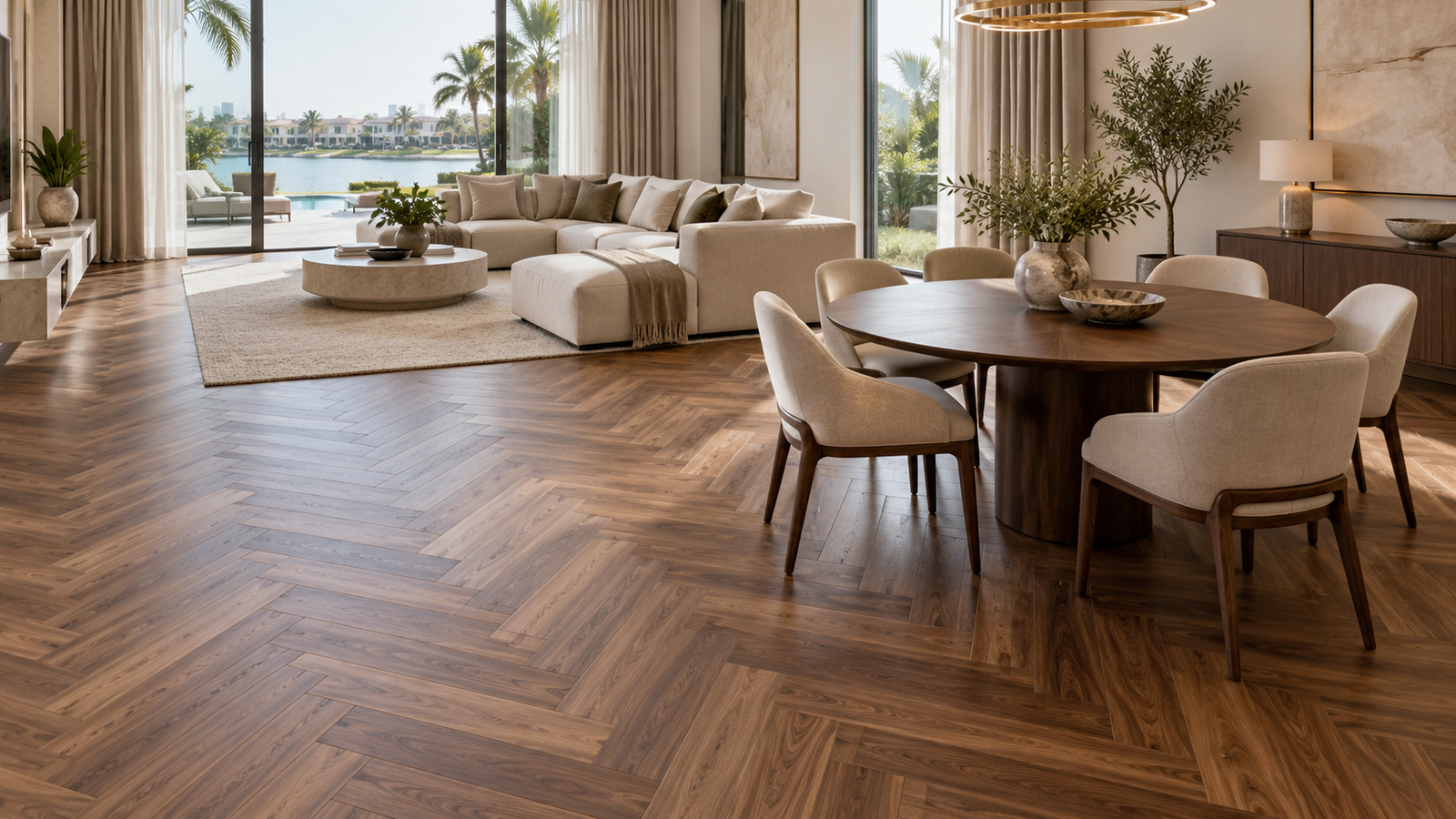
SPC is available in many wood and stone designs, while LVT offers broad design flexibility in both plank and tile formats. Some LVT products are especially suitable for patterns that require a bonded installation, such as certain herringbone layouts. Availability depends on the product collection.
Before purchasing, view full size samples under the lighting conditions in your own home. A sample that looks warm in a showroom may appear cooler beside white walls or under bright LED lighting.
For homeowners comparing different materials and finishes, explore engineered wood flooring options alongside vinyl flooring to understand the differences in appearance, maintenance, and construction.
The best flooring material can vary from one room to another. A home does not necessarily need the same specification throughout every space.
SPC can be a practical choice for busy living rooms, especially where there is frequent foot traffic, heavy furniture, or strong sunlight. LVT may be preferable when a softer feel and a slim finished profile are more important.
The decision should also account for the existing subfloor and the amount of direct sunlight entering the room.
Flexible LVT can suit bedrooms where comfort and a quieter feel are priorities. SPC can also work well, particularly when it has a suitable acoustic backing and the homeowner prefers a firmer floor.
Choose a finish that complements the bed, wardrobes, wall colours, and available natural light.
SPC is often a sensible choice for kitchens because its rigid core is waterproof and generally resistant to indentation. Spills should still be cleaned promptly, and the installation needs appropriate finishing around cabinets, appliances, and room edges.
Some LVT products are also suitable for kitchens. Check the manufacturer’s guidance for water exposure and cleaning requirements before installation.
Do not select flooring for a bathroom based on the word waterproof alone. Confirm that the particular product is approved for the intended area and that the installation details suit the room. Shower areas and continuously wet zones may require a separate waterproofing system and a different flooring specification.
For rental properties, SPC can offer a practical combination of durability, attractive appearance, and relatively straightforward maintenance. Flexible LVT may be appropriate where initial cost, low floor height, or a bonded installation is the priority.
Consider expected tenant use, the cost of future repairs, and how easily replacement material can be sourced. This flooring guide for Dubai rental properties can help you assess the requirements of a rental renovation.
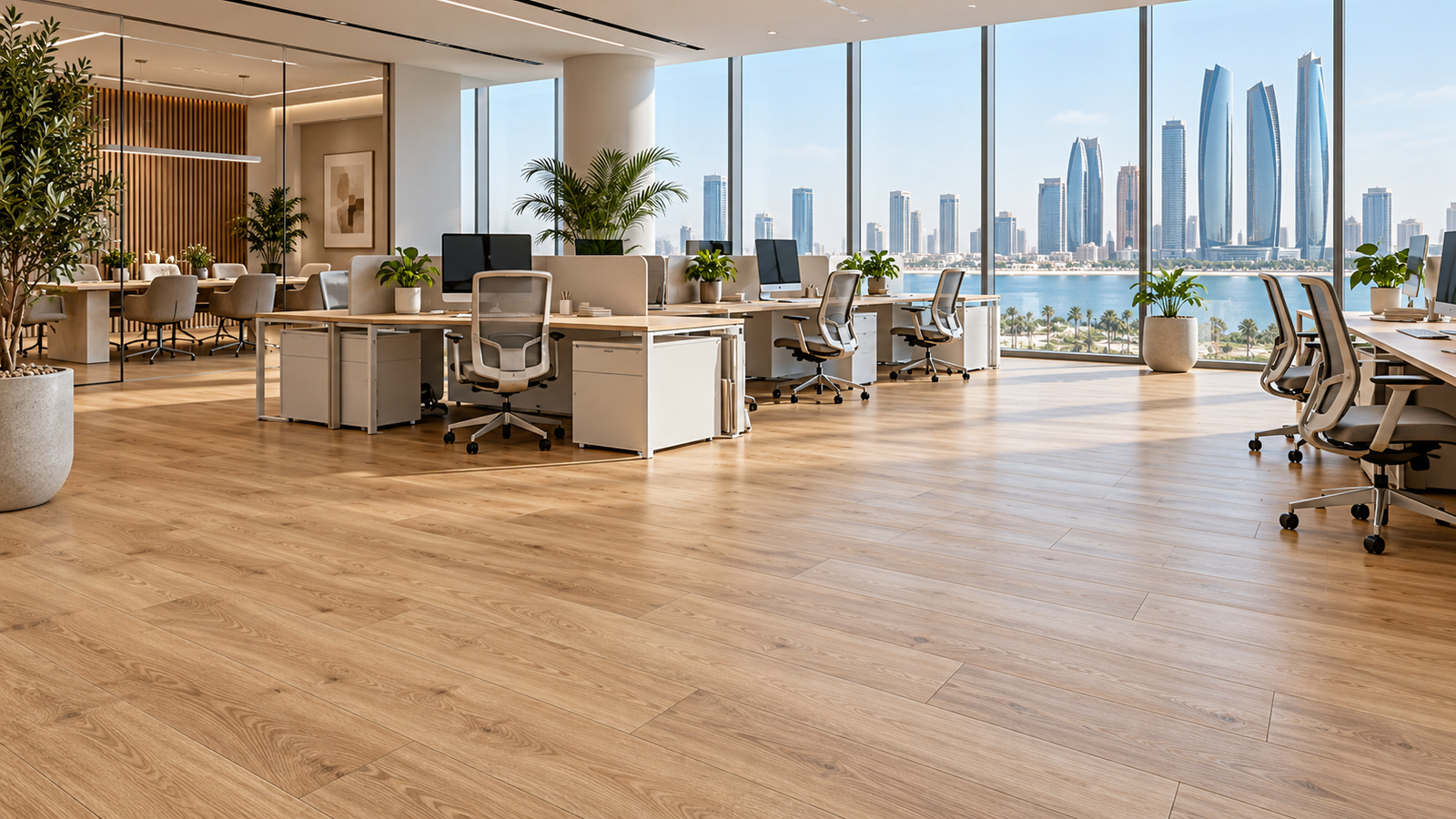
Both materials can work in commercial environments, but the selection should reflect foot traffic, rolling chairs, maintenance schedules, and the type of subfloor. Glue down LVT can be suitable for some commercial layouts, while SPC can work well in spaces that benefit from a rigid click system.
For more options, review these office flooring solutions in the UAE.
Both LVT and SPC flooring are relatively easy to maintain. Regular cleaning helps remove the fine sand and dust that can enter UAE homes on shoes, clothing, and through open doors.
Use a soft broom, vacuum suitable for hard floors, or a microfibre mop to remove loose dirt. Clean spills promptly and use a damp mop with a cleaner approved for the specific flooring product. Avoid abrasive tools, harsh chemicals, and excessive water unless the manufacturer explicitly permits them.
Place entrance mats in suitable locations to capture sand before it spreads across the floor. Use protective pads beneath furniture legs and lift heavy items rather than dragging them. Chairs with wheels should use suitable castors or floor protection.
SPC’s rigid core may provide better resistance to indentation, but its surface can still scratch or become damaged. LVT also benefits from sensible furniture protection and regular cleaning.
Follow the manufacturer’s guidance for steam cleaners, cleaning products, and repair methods. Do not assume that every product has the same care requirements.
For further advice, read this guide to maintaining vinyl flooring in the Dubai climate.
A common mistake is choosing flooring based only on its appearance or advertised price. A beautiful plank will not perform well if the product is unsuitable for the room or installed over an unstable surface.
Another mistake is treating all vinyl flooring as identical. Traditional flexible LVT, click LVT, and SPC have different construction and installation requirements. Ask the supplier to identify the exact product type rather than relying on a general label.
Some homeowners also overlook the wear layer. Total plank thickness and wear layer thickness are different measurements, and both should be evaluated according to the intended use.
Ignoring sunlight exposure can also create problems. Rooms that become excessively hot may require a product specifically approved for those conditions, along with appropriate installation clearances.
Finally, do not skip subfloor checks. Loose tiles, uneven surfaces, trapped moisture, and unsuitable underlay can affect the finished floor regardless of the material selected.
Review these flooring mistakes to avoid during UAE renovations before placing an order or scheduling installation.
SPC is often the practical starting point for UAE homes where dimensional stability, resistance to indentation, and a rigid waterproof core are priorities. LVT can be a better fit where a softer feel, slim profile, or bonded installation matters more. The right choice depends on the product specification, room conditions, and subfloor.
SPC generally has an advantage in resistance to indentation because of its dense, rigid core. However, surface durability also depends on the wear layer, product quality, installation, and daily use. A well specified LVT product can provide excellent service in suitable conditions.
Water resistance varies by LVT product. Some products are rated as waterproof, while others have different limitations. Check the manufacturer’s documentation, and remember that water can still reach the subfloor through joints, edges, or poorly finished transitions.
SPC can often be installed over existing tiles if the tiles are secure, the surface meets the required flatness tolerance, and the product manufacturer permits this method. Deep grout lines, loose tiles, and uneven areas may need repair or levelling before installation.
Yes, SPC generally feels firmer because it has a rigid composite core. Flexible LVT often feels softer underfoot. The backing and underlay can influence comfort and sound, so compare complete product samples rather than relying only on the material name.
SPC is often a practical kitchen choice because its rigid core is waterproof and generally resists indentation well. Suitable LVT products can also work in kitchens. Correct installation and careful finishing around edges remain important for both materials.
The answer depends on the specific product and installation requirements. Some LVT products have a lower material price, but glue down installation may require additional subfloor preparation. Compare itemised installed quotations to understand the actual cost difference.
Both can be affected by prolonged direct sunlight, depending on the product and its protective layers. Strong sunlight can also heat the floor and affect dimensional stability. Check the manufacturer’s UV and temperature guidance, and manage intense sunlight with suitable window coverings where appropriate.
Yes. SPC can be used in bedrooms where a durable, easy to maintain floor is desired. If comfort and sound are priorities, compare products with approved acoustic backing and consider whether flexible LVT better suits the room.
Look for clear product specifications, transparent quotations, suitable samples, installation expertise, and written warranty terms. A reliable supplier should explain the differences between LVT and SPC, assess your subfloor, and recommend a product based on the room rather than simply selling the most expensive option.
When comparing LVT vs SPC flooring, the most important step is to match the product to your property, rather than assuming one material is always superior. SPC is often a strong option for busy rooms, renovation projects, and areas where a rigid core and dimensional stability matter. Traditional flexible LVT can be an excellent choice for interiors where comfort, a slim profile, or a bonded installation is preferred.
Before making your decision, compare samples, check wear layer specifications, assess direct sunlight exposure, and confirm the condition of your subfloor. Ask for an itemised quotation that includes preparation, installation, trims, and any approved underlay.
Explore the flooring options available from Urban Floors and request advice based on your room dimensions, preferred finish, and installation requirements. A properly selected and professionally installed floor will give your home a more attractive finish and help protect your investment over time.
Category :
Share :
WhatsApp us