
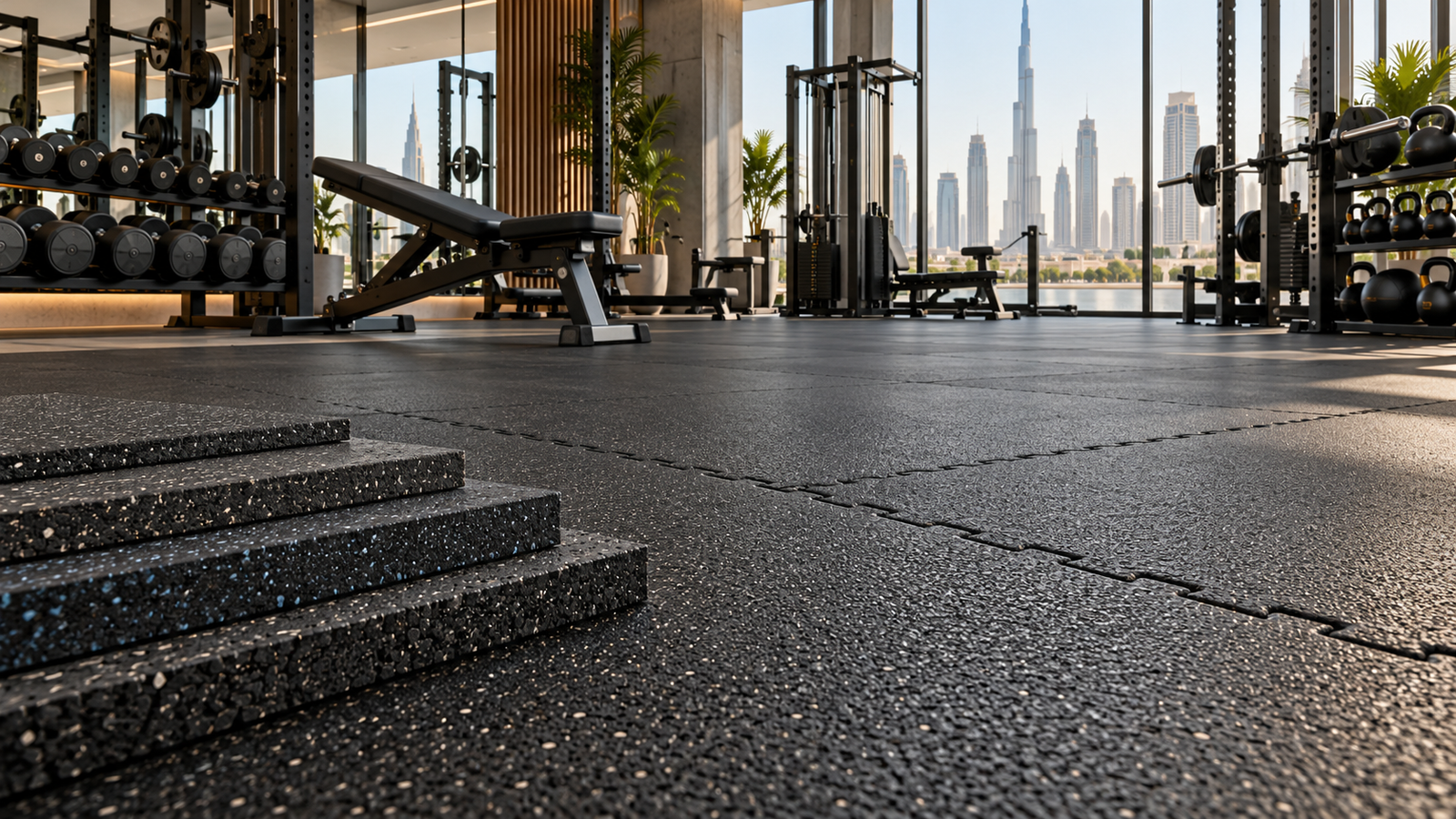
Choosing the right gym floor is about more than creating a professional looking workout space. The surface needs to support exercise equipment, provide reliable grip, reduce impact and remain practical to clean. For homeowners, fitness studios, hotels and commercial gyms, rubber gym flooring UAE offers a durable solution for everyday training and heavier workouts.
Rubber flooring is available in several formats, including rolls, interlocking tiles and individual gym mats. Each option serves a different purpose. Rolls provide broad coverage across larger spaces, tiles offer flexibility for smaller rooms and changing layouts, while thicker rubber mats can provide extra protection in weightlifting zones.
The right choice depends on how you plan to use the gym, the equipment you intend to install, the condition of the existing floor and the amount of impact the surface must withstand. Climate and indoor conditions also matter in the UAE, where air conditioning, dust, humidity and frequent cleaning can influence flooring maintenance.
This guide explains the main types of rubber gym flooring, how to choose the right thickness, what to consider before installation and how to compare solutions for home and commercial fitness spaces.
Rubber gym flooring is a protective floor covering designed for exercise areas. It is manufactured from rubber materials that provide grip, durability and a degree of impact absorption. Depending on the product, the rubber may be supplied as tiles, continuous rolls, loose mats or specialist lifting surfaces.
Unlike ordinary decorative flooring, gym flooring must handle repeated movement, equipment loads and occasional impacts. A treadmill places a sustained load on a small area, while dumbbells and barbells can create concentrated impact when they are placed down or dropped. The floor must be suitable for these demands without becoming unstable underfoot.
Rubber flooring is commonly used in home gyms, apartment fitness rooms, personal training studios, commercial gyms, hotel fitness centres and designated workout areas in offices or residential buildings.
Rubber offers several practical benefits. Its textured surface can provide useful traction during strength training and functional exercises. Its resilient construction can help absorb some impact from equipment and reduce direct contact with the underlying floor. It can also help limit some workout noise, although the amount of noise reduction depends on the product, floor structure and installation method.
Rubber is also available in different thicknesses, densities, colours and surface finishes. This makes it possible to create a consistent floor throughout a gym while using additional protection where heavier activities take place.
However, rubber flooring is not a complete soundproofing system, and no single thickness is suitable for every activity. The product should be selected according to the actual training requirements.
Before choosing a thickness or finish, decide which format suits your space. The three main options are rubber rolls, rubber tiles and individual gym mats. Each has advantages depending on the size of the room, the training activities and the preferred installation method.
Rubber rolls are supplied in long sheets that cover a large floor area with relatively few joins. They are often suitable for commercial gyms, cardio areas, fitness studios and open training spaces where a consistent appearance is important.
Fewer joins can make the surface easier to maintain because there are fewer edges where dust and debris may collect. Rolls can also create a more uniform appearance across a large room.
The main consideration is installation. The subfloor generally needs to be clean, dry, stable and level. Depending on the product, the rolls may require adhesive or another specified fixing method. Accurate cutting is also necessary around columns, doorways, equipment bases and other obstacles.
Rubber rolls are a practical option when you need to cover a substantial area without installing numerous individual tiles. They may be less convenient in rooms that require frequent layout changes or where sections need to be removed for access.
Rubber tiles are modular sections that fit together to cover a floor. Some have straight edges and require a suitable fixing method, while interlocking designs use connecting edges to help keep neighbouring tiles aligned.
Tiles work well in home gyms, garage workout spaces, apartment fitness rooms and smaller commercial studios. Their modular construction can make transport and handling easier, particularly when access is limited.
One advantage is that individual tiles may be replaced if a section becomes damaged, provided a matching product remains available. Tiles can also help divide a gym into separate zones for cardio, weights and stretching.
The joins need attention during installation and cleaning. Poorly fitted tiles may shift, separate or create uneven edges. Interlocking tiles should not automatically be treated as suitable for heavy dropped weights simply because they fit together. Thickness, density, construction and the manufacturer’s intended use all matter.
Individual mats are useful when protection is needed in a specific area rather than across an entire room. They can be placed beneath selected equipment or used to create a dedicated workout station.
For example, a homeowner may want a mat beneath a weight bench, while a personal trainer may need separate surfaces for kettlebell exercises and stretching. Mats can also be useful where a gym layout is temporary or likely to change.
The main limitation is coverage. Individual mats may leave gaps between protected areas, and loose edges can move if the product is not designed to remain stable under the intended activity.
For a large commercial gym, rubber rolls may be suitable across open cardio and general training areas. For a smaller home gym, modular tiles can provide flexibility and easier replacement. For heavy lifting, dedicated thick rubber mats or a properly designed lifting platform may offer more suitable protection.
Many facilities use a combination of formats rather than relying on a single product throughout the building.
Thickness is one of the most important decisions when selecting rubber gym flooring. A thicker product may offer greater impact protection, but thickness alone does not determine performance. Rubber density, composition, resilience, equipment weight and the type of impact all affect the result.
The ranges below are starting points for comparing products, not universal engineering specifications. Always check the manufacturer’s recommendations and consider the equipment and training activities involved.
Thinner rubber flooring may suit stretching areas, light exercise rooms and some cardio spaces where heavy weights are not dropped. It can provide a more comfortable, grippy surface than an unprotected hard floor.
This thickness may be appropriate for activities such as mobility work, light bodyweight exercises and general movement. The final choice depends on the product’s construction and the condition of the existing floor.
For treadmills and other heavy machines, check the manufacturer’s guidance on floor protection, stability and vibration. A thin rubber surface should not be assumed to provide enough protection for every machine.
Rubber flooring in this range is commonly considered for home gyms that combine cardio equipment, bodyweight training and moderate strength exercises.
It can provide a useful protective layer beneath exercise equipment and help define a workout area. It may also be suitable for dumbbell training when the weights are handled carefully rather than repeatedly dropped.
For a home gym in a villa or apartment, consider the type of subfloor beneath the rubber. Decorative tiles, concrete and timber floors have different characteristics, and the product must be compatible with the surface underneath.
Medium to thicker rubber flooring may be suitable for general free weight areas, functional training and selected commercial applications. It can provide more material between the equipment and the subfloor than a thin roll.
This range may work for spaces using dumbbells, kettlebells, weight benches and strength equipment, provided the product is designed for those activities.
If users regularly drop weights, the flooring specification should account for the actual load and drop height. The weight of a dumbbell placed carefully on the floor is different from a loaded barbell dropped repeatedly during an intense workout.
Thicker rubber tiles or mats may be appropriate for demanding free weight zones and some functional training environments. They provide additional material to help manage impact, although the amount of protection still depends on density, construction and the supporting floor.
For commercial gyms, the right specification should reflect the equipment being used, how frequently weights are dropped and whether other people occupy rooms below the workout area.
Very thick rubber products may be considered for specialist weightlifting areas where repeated heavy impacts are expected. These applications may require dedicated lifting platforms or a complete floor system rather than a thicker tile alone.
Before installation, check the expected impact loads, slab condition and product test data. A flooring supplier or qualified installer can help identify whether a standard rubber tile is appropriate or a specialist platform is needed.
| Thickness range | Potential application | Important consideration |
|---|---|---|
| 6 mm to 8 mm | Light exercise and selected studio areas | Limited protection against heavy impacts |
| 8 mm to 12 mm | General home gym and cardio zones | Check machine stability and subfloor needs |
| 15 mm to 20 mm | Free weights and functional training | Confirm suitability for equipment loads |
| 25 mm to 30 mm | Higher impact training zones | Consider impact frequency and density |
| 40 mm to 50 mm | Specialist lifting areas | May require a dedicated platform and technical assessment |
The key principle is to select flooring according to the activity taking place in each zone. Installing the thickest option everywhere can increase project costs without providing a useful benefit in areas where heavy impact does not occur.
Home gyms often have different requirements from commercial fitness centres. Available space may be limited, the floor may already have a decorative finish, and the room may serve another purpose when exercise equipment is not in use.
A practical choice should balance comfort, protection, appearance, maintenance and ease of installation.
Measure the length and width of the workout area and identify any corners, columns, doorways or fixed cabinets. Calculate the total floor area and allow for reasonable cutting waste based on the room layout and product format.
For example, a simple rectangular room is generally easier to cover than a room with several recesses. Rolls may suit a straightforward open space, while modular tiles can be easier to handle in a room with awkward dimensions.
Also consider the equipment footprint. The floor may need to extend beyond the machine itself to provide space for movement, access and safe exercise.
A rubber surface does not eliminate the need for proper subfloor preparation. Loose tiles, uneven concrete, moisture problems or unstable flooring can affect the result.
If the existing surface is decorative tile, check that it is sound and capable of supporting the intended equipment. For timber or other specialist floor constructions, confirm compatibility with the selected rubber product and fixing method.
Avoid covering a damp floor without identifying and addressing the source of moisture. Trapping moisture underneath an unsuitable floor covering can create maintenance problems.
Interlocking tiles may be a convenient option for a spare room or home workout space because sections can be handled individually. Rolls may be preferable when a continuous finish is the priority and the installation area is relatively open.
If you expect to add equipment later, modular flooring may make it easier to extend the protected area. However, new tiles must match the existing product in thickness, dimensions and connection style.
Homeowners renovating other rooms can also compare different floor materials through this guide to flooring for villas and apartments, especially when deciding how the gym should relate to adjoining living areas.
Commercial gyms experience more frequent use than most home workout spaces. Members may move equipment, exercise with different weights and train throughout the day. The flooring must support this routine while remaining practical to maintain.
Fitness studios, hotel gyms, residential building facilities and dedicated strength training centres may each require different specifications.
Start by identifying how each part of the room will be used. Cardio machines, free weights, functional training, stretching and circulation areas create different demands on the floor.
Cardio areas generally prioritise stability, cleaning and comfort. Free weight zones may require greater impact protection. Stretching areas need a suitable surface for controlled movement, while walkways should have stable transitions without raised edges.
Using a zone based approach helps avoid paying for heavy duty flooring in areas that do not need it, while preventing under specification in the sections exposed to repeated impacts.
Commercial floors may be cleaned frequently and exposed to sweat, dust, shoe marks and equipment movement. Choose a surface that can withstand the cleaning products and maintenance routine planned for the facility.
The floor should also allow staff to inspect joins and edges, move cleaning equipment easily and identify damaged sections before they become a safety concern.
A product designed for light domestic use may not offer the durability needed for a busy fitness centre. Confirm the intended commercial use with the supplier before ordering.
Noise can be a concern in gyms located above apartments, hotel rooms, offices or other occupied spaces. Rubber may help reduce some impact noise, but it does not automatically prevent vibration from travelling through the building structure.
If repeated weight drops are expected, consider the floor slab, any occupied space below and the type of sound transmission that needs to be controlled. Specialist acoustic layers or engineered platforms may be required.
For other business environments, Urban Floors also provides information about office flooring solutions, which can help when planning adjoining reception areas or shared commercial spaces.
Not all rubber flooring products are manufactured in the same way. Material composition, density, surface texture and manufacturing quality influence how the floor performs over time.
Some gym flooring products use recycled rubber granules bonded together to create a resilient surface. These products are widely used in fitness applications because they can provide a durable, textured finish.
Other products incorporate synthetic rubber materials or coloured surface layers. The best option depends on the intended use, required appearance, product specifications and budget.
Ask the supplier about the composition of the product, its intended application, expected wear and cleaning requirements. If the gym has particular indoor air quality requirements, request relevant emissions or material documentation rather than relying on general claims.
A textured surface can help provide traction during exercise, but grip depends on more than appearance. The type of rubber, surface pattern, footwear and presence of sweat or cleaning residue all affect performance.
Choose a product designed for the intended activity and keep the surface clean. Do not assume that every rubber finish is suitable for every workout, particularly activities that involve quick changes of direction.
Black rubber is a common choice for strength areas because it has a practical, understated appearance. Some products include coloured flecks or decorative surface layers that can complement a gym’s branding.
Colour zoning can also help separate cardio, weights and functional training areas. If using different products in adjoining sections, check that their thicknesses and finished heights create safe transitions.
For spaces that combine different flooring materials, compare the needs of the workout area with the requirements of adjacent rooms. For example, SPC and laminate flooring options may be relevant to the surrounding interior, but ordinary decorative flooring should not replace purpose designed impact protection in a heavy lifting zone.
The UAE climate creates practical considerations for flooring selection and maintenance. High outdoor temperatures, humidity, airborne sand and extensive use of air conditioning can affect how indoor spaces are managed.
Rubber gym flooring can be a suitable choice for many indoor fitness areas, but its performance still depends on product quality, installation and ongoing care.
Many gyms operate in air conditioned buildings, which means the floor is exposed to indoor conditions rather than the full outdoor climate. Nevertheless, areas near windows, external doors or poorly insulated spaces may experience greater temperature changes.
Check the manufacturer’s temperature guidance and ensure that the product and any adhesive are appropriate for the installation environment. Avoid assuming that a material suitable for an indoor room will also be suitable for an exposed outdoor training area.
For broader advice on indoor flooring performance, see this guide to flooring during Dubai summer heat.
Humidity can become a concern when condensation, leaks or inadequate ventilation introduce moisture beneath a floor covering. Rubber products may have different moisture tolerances, so the subfloor and installation method should be checked before work begins.
The floor should be installed on a surface that meets the manufacturer’s moisture requirements. If moisture is present, investigate the cause rather than covering it with rubber tiles or rolls.
This is especially relevant in ground floor rooms, garages and areas near wet spaces. Guidance on flooring for UAE humidity and sand can help with wider flooring decisions around the property.
Fine dust and sand can enter a gym on shoes, equipment wheels and through open doors. Regular sweeping or vacuuming helps prevent grit from collecting around tile edges and beneath movable equipment.
Use entry mats where practical and establish a cleaning routine that suits the number of people using the facility. In commercial gyms, staff should pay attention to corners, machine bases and joins where debris may collect.
Rubber gym flooring should be cleaned using products approved by its manufacturer. Strong solvents, unsuitable chemicals or excessive water may damage some finishes or affect adhesives.
Allow the floor to dry according to the product instructions and maintain suitable ventilation. New flooring can have a noticeable material odour, particularly immediately after installation. Follow the supplier’s guidance on ventilation and the time required before the area is ready for normal use.
A quality product can still perform poorly if it is installed over an unsuitable surface or used outside its intended application. Careful preparation is therefore just as important as selecting the right material.
The installer should check that the subfloor is stable, clean, dry and sufficiently level for the chosen system. Dust, loose debris, damaged areas and moisture problems should be addressed before installation.
The required preparation depends on the existing floor and whether the rubber is loose laid, interlocking or bonded with adhesive. Follow the manufacturer’s instructions rather than assuming that all rubber flooring uses the same method.
Check door clearances, floor transitions and the finished height beneath fixed equipment. A thicker surface may affect how a door opens or create a height difference where the gym meets another room.
Heavy machines should be positioned according to their manufacturer’s requirements. The flooring must support their weight without causing instability, excessive movement or damage to the product.
A cardio area and a heavy lifting platform have different requirements. Using the same thin flooring throughout a gym may leave the lifting area insufficiently protected, while using specialist thick flooring everywhere can increase cost unnecessarily.
Plan the room by activity and specify the appropriate product for each section.
After installation, check that tiles fit correctly, rolls lie flat and transitions are secure. Loose corners and uneven edges can create trip hazards and allow debris to collect beneath the surface.
During routine maintenance, inspect areas that receive the most traffic or impact. Replace damaged sections where possible and investigate recurring movement or separation instead of repeatedly covering the problem.
For projects involving several types of flooring across a property, consider professional flooring installation services to ensure the selected materials are fitted according to their requirements.
A common mistake is to buy gym flooring based only on price, colour or thickness. A product that works well for stretching may not be suitable for repeated barbell drops.
Another mistake is assuming that rubber is completely waterproof or soundproof. The material, joins, backing and installation system determine how the finished floor handles moisture and noise.
Before ordering, explain the training activities, equipment, room size and condition of the existing floor to the supplier. Ask for written product specifications and clarification of any limitations.
The cost of rubber gym flooring varies by product, thickness, quality and project requirements. A useful comparison should consider the full installed cost rather than the price of the material alone.
Rubber rolls, interlocking tiles and specialist lifting mats have different manufacturing, transport and installation requirements. Thicker or specially constructed products may cost more because they use more material or require additional performance features.
A decorative finish, coloured flecks or a custom layout may also affect the quotation.
Larger projects may benefit from more efficient material coverage, especially when rolls can be installed across open spaces. However, the final price depends on the shape of the room, the amount of cutting, the chosen product and installation complexity.
Smaller rooms may need more careful cutting around equipment, cupboards and doorways, which can influence labour and waste.
A clean, level and suitable subfloor can make installation more straightforward. Repairs, levelling, moisture treatment or removal of an existing floor may add to the overall project cost.
Adhesive requirements, access restrictions and the need to work around fixed equipment can also affect labour.
When requesting quotations, ask each supplier to specify the product format, thickness, material construction, coverage area, installation method and preparation work included. Confirm whether cutting waste, delivery and finishing details are included in the price.
Compare products with similar specifications rather than choosing the lowest price without checking what is being supplied. A cheaper floor may not be economical if it wears quickly or is unsuitable for the intended training.
If you are budgeting for a wider renovation, the Dubai flooring cost guide provides additional context for comparing flooring expenses across different applications.
The best option depends on the type of training, floor area and equipment. Rubber rolls often suit large open gym areas, interlocking tiles can work well in home gyms and flexible layouts, and thicker mats or platforms may be needed for heavy lifting. Check the product specifications before making a final decision.
Light exercise areas may use thinner rubber products, while general home gyms and free weight zones may need thicker options. Heavy lifting areas can require specialist high impact flooring or platforms. Select thickness according to the activity, product density, expected impact and subfloor rather than thickness alone.
Neither format is automatically better for every gym. Tiles offer modular coverage and may allow individual sections to be replaced, while rolls create a more continuous finish with fewer joins. The preferred format depends on room dimensions, installation requirements, maintenance and the gym’s intended use.
Rubber flooring can be suitable for apartment workout areas when the product is appropriate for the exercise and building conditions. However, rubber alone may not prevent impact vibration from travelling through the structure. Check the building’s rules, the subfloor and any requirements for noise control before installing heavy workout equipment.
Rubber flooring can help protect the underlying surface from everyday equipment contact, scuffs and some impacts. The degree of protection depends on the product, thickness, density and activity. Heavy dropped weights may require a dedicated lifting surface, and the existing floor must be suitable for the loads involved.
It may be possible if the tiles are stable, level, clean and compatible with the chosen installation method. Loose or damaged tiles and moisture problems should be addressed first. Check the manufacturer’s instructions to determine whether loose laying, interlocking or adhesive installation is appropriate for the existing surface.
Most gym rubber surfaces can be maintained with regular sweeping or vacuuming and cleaning using an approved product. The exact method depends on the rubber composition and finish. Avoid harsh chemicals unless the manufacturer confirms they are suitable, and do not leave excess water beneath a floor system that is not designed for it.
Its service life depends on material quality, traffic, equipment loads, maintenance and installation. A lightly used home gym may place different demands on the floor than a busy commercial fitness centre. Regular inspection, correct cleaning and choosing a product designed for the intended use can help extend its useful life.
Some rubber products are designed for outdoor use, but indoor gym flooring should not automatically be installed outside. Outdoor areas may face direct sunlight, heat, moisture and greater weather exposure. Check that the selected material, backing and fixing system are rated for the actual environment.
Not necessarily. Cardio areas, stretching spaces and heavy lifting zones have different requirements. A zone based approach allows you to choose suitable flooring for each activity while keeping the overall design consistent. For demanding lifting areas, obtain product guidance based on the expected impact and equipment.
The best rubber gym flooring UAE solution starts with understanding how the space will be used. Rubber rolls can be a practical choice for large open areas, tiles provide flexibility for home gyms and changing layouts, and specialist mats or platforms can offer additional protection for heavy lifting.
Before choosing a product, measure the area, inspect the subfloor, identify the equipment loads and decide which activities will take place in each zone. Then compare the material construction, thickness, installation method and maintenance requirements.
Urban Floors can help you compare flooring options for different interiors and project needs. Explore the available flooring solutions from Urban Floors and discuss your room size, intended use and preferred finish before finalising your specification.
Category :
Share :
WhatsApp us