
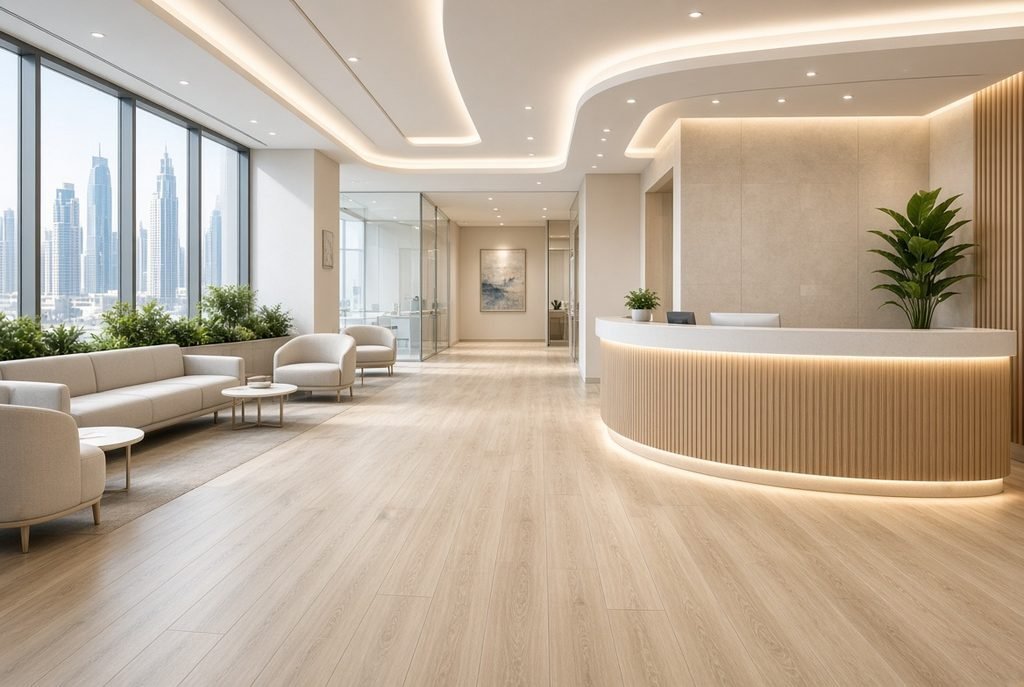
Choosing the right healthcare flooring Dubai solution is essential for hospitals, clinics, dental practices, medical centres, laboratories, pharmacies, rehabilitation centres, and other healthcare facilities. Healthcare floors must do more than look professional. They need to withstand heavy foot traffic, frequent cleaning, moisture, equipment movement, spills, and demanding daily use while providing a safe and comfortable environment for patients, visitors, doctors, nurses, and staff.
The best healthcare flooring options combine durability, hygiene, easy maintenance, moisture resistance, safety, comfort, and professional appearance. Depending on the area, suitable materials can include commercial vinyl, SPC, porcelain tile, rubber flooring, sheet flooring, and other specialised commercial surfaces.
Healthcare flooring refers to flooring systems selected specifically for medical and healthcare environments. These spaces have different requirements from ordinary homes and offices because cleanliness, safety, durability, and maintenance are particularly important.
A suitable healthcare flooring solution should provide:
Different parts of a healthcare facility can also require different flooring materials.
For example, a reception area may prioritise appearance, while a treatment room may place greater importance on hygiene and easy cleaning.
Dubai healthcare facilities operate in a demanding environment. Hospitals and clinics can remain busy throughout the day, with patients, medical professionals, visitors, cleaning teams, and equipment constantly moving through the building.
Healthcare flooring must therefore withstand:
Choosing flooring based only on appearance can create problems later. A material that looks excellent in a showroom may not be appropriate for a busy medical facility.
There is no single flooring material suitable for every healthcare space. The best approach is to match the flooring with the function of each area.
Commercial vinyl flooring is one of the practical options for healthcare environments because it can combine durability, easy maintenance, moisture resistance, and attractive designs.
Modern vinyl can reproduce wood, stone, and other finishes while providing a practical surface for commercial interiors.
You can explore vinyl flooring UAE when considering vinyl solutions for healthcare projects.
Benefits include:
Vinyl can be considered for clinics, reception areas, consultation rooms, offices, corridors, waiting areas, and other suitable spaces.
SPC flooring provides a rigid construction that can work well in selected commercial healthcare areas.
It is available in modern wood and stone designs, allowing healthcare facilities to create a professional interior without relying exclusively on ceramic or natural materials.
Explore SPC flooring UAE for more information about SPC applications.
SPC can offer:
SPC can be useful for clinics, medical offices, waiting areas, administrative areas, and other spaces where its specific performance characteristics meet project requirements.
Porcelain tile is another durable flooring option for healthcare facilities.
It can provide a hard wearing surface suitable for areas exposed to frequent cleaning and moisture.
Common applications can include:
Large format porcelain can also create a clean and contemporary appearance.
However, healthcare facilities should consider grout maintenance and slip resistance when selecting tile systems.
Rubber flooring can be useful in healthcare environments where comfort, noise reduction, durability, and slip resistance are priorities.
It can provide a softer walking surface compared with hard tile and may be appropriate for selected:
The exact product should be selected according to the requirements of the facility.
Seamless or reduced seam flooring systems can be considered for specialised healthcare areas where hygiene and easy cleaning are particularly important.
Fewer joints can make cleaning easier and reduce areas where dirt and contaminants can accumulate.
This type of flooring may be considered for specific medical environments depending on project specifications and applicable requirements.
The reception area creates the first impression for patients and visitors.
Healthcare reception flooring should therefore balance professional appearance with durability and easy maintenance.
Suitable options can include:
A healthcare reception does not need to look clinical or sterile. Modern wood and stone look flooring can create a warmer environment while maintaining a professional appearance.
Hospital corridors experience constant movement throughout the day.
Patients, doctors, nurses, visitors, wheelchairs, beds, medical carts, and equipment can all travel through these areas.
Corridor flooring should therefore provide:
Commercial vinyl, rubber, and specialised healthcare flooring systems can be considered depending on the facility.
Clinics often have smaller spaces than hospitals but still require flooring capable of handling regular patient traffic and frequent cleaning.
Clinic flooring may be required in:
Vinyl can be a practical choice for many general clinic applications because it offers a combination of appearance, maintenance, and moisture resistance.
Dental clinics require flooring that can handle frequent cleaning and everyday patient traffic.
Flooring should also complement the clean and modern appearance expected in a dental environment.
Potential options include:
The appropriate choice depends on the room function, cleaning procedures, equipment, and project requirements.
Waiting rooms need to feel clean, comfortable, and welcoming.
Patients may spend significant periods sitting in these spaces, so the interior should avoid creating an unnecessarily cold or industrial atmosphere.
Wood look vinyl or SPC can provide a warmer visual appearance while remaining practical for commercial use.
Healthcare waiting room flooring should also be:
Healthcare bathrooms have significant moisture exposure and require appropriate slip performance.
Flooring should be:
Porcelain and ceramic tiles are common choices, while selected waterproof flooring systems can also be considered.
For moisture exposed applications, see waterproof flooring Dubai.
Laboratories can have demanding flooring requirements because of equipment, cleaning, spills, and frequent movement.
The flooring specification should consider:
The appropriate flooring should be selected based on the specific laboratory activities rather than using a general residential product.
Hygiene is one of the most important considerations when selecting flooring for healthcare facilities.
Flooring should allow cleaning teams to remove dust, dirt, spills, and other contaminants efficiently.
Important considerations include:
The flooring itself cannot replace proper healthcare cleaning procedures, but an appropriate surface can make routine maintenance easier.
Healthcare facilities need to consider slip risks carefully.
Patients may have limited mobility, and floors can sometimes become wet because of cleaning, spills, bathrooms, or other activities.
Flooring selection should therefore consider:
Slip resistance should be evaluated according to the specific environment rather than assuming one flooring product is appropriate everywhere.
Hospitals and clinics experience constant movement of wheelchairs, beds, carts, and medical equipment.
Flooring should be capable of handling this type of traffic without quickly developing visible damage.
Important factors include:
A flooring product that works well in a private home may not necessarily be appropriate for heavy healthcare traffic.
Dubai’s climate introduces additional considerations when selecting commercial flooring.
Heat, humidity, air conditioning, dust, and sand can affect flooring environments.
Healthcare facilities should consider:
For additional UAE climate considerations, see humidity resistant flooring.
Healthcare flooring should support efficient cleaning routines.
A busy facility cannot afford flooring that requires complicated daily maintenance.
Practical maintenance usually includes:
For vinyl surfaces, maintaining vinyl flooring can provide useful maintenance guidance.
High traffic areas require flooring with strong wear resistance.
These can include:
Using higher performance flooring in these areas can help reduce premature replacement.
Patient rooms need to balance hygiene, comfort, durability, and appearance.
A completely clinical appearance is not always necessary. Modern wood look flooring can make patient rooms feel warmer and more welcoming.
Potential options include:
The final selection should reflect the cleaning requirements, patient needs, traffic levels, and facility specifications.
Medical offices and administrative spaces generally experience lower traffic than treatment areas.
This provides more flexibility when selecting flooring.
Possible options include:
Laminate can provide a wood appearance in suitable low moisture areas. Compare SPC versus laminate before selecting between the two.
Selecting healthcare flooring should involve more than comparing product prices.
Start by determining exactly how the space will be used.
A reception area has different requirements from a treatment room or laboratory.
Estimate the number of people and equipment movements expected each day.
Bathrooms, cleaning areas, laboratories, and other wet environments require appropriate moisture performance.
Make sure the flooring is compatible with the facility’s cleaning procedures.
Consider slip resistance, movement, and accessibility requirements.
Patients and healthcare workers may spend long periods walking or standing.
Modern healthcare facilities often benefit from flooring that feels professional without appearing overly clinical.
Proper subfloor preparation and professional installation are essential for long term performance.
Even high quality flooring can perform poorly when installation is not completed correctly.
Professional installation should consider:
Professional installation is particularly important in healthcare projects because flooring problems can disrupt normal operations.
You can explore professional flooring installation when planning a commercial project.
Healthcare facilities need to manage budgets carefully, but the cheapest flooring is not always the most economical option.
A better approach is to evaluate the total cost of ownership.
This includes:
SPC and vinyl can provide practical options for facilities looking for a balance between appearance, performance, and budget.
Renovating an operating healthcare facility requires careful scheduling.
Flooring work may need to be completed in stages to minimise disruption.
Project planning should consider:
A professional flooring supplier can help coordinate material supply and installation according to the project schedule.
A visually attractive product may not have the performance required for a medical facility.
Healthcare flooring should be selected according to actual usage.
Residential flooring may not provide the durability required for continuous commercial traffic.
The flooring should work with the facility’s cleaning and maintenance procedures.
Uneven or damaged surfaces can affect the final installation.
A low initial price may lead to higher maintenance or replacement costs.
Different healthcare areas have different requirements, so a single flooring material may not be ideal throughout the facility.
For broader renovation guidance, see flooring mistakes to avoid.
Healthcare flooring prices can vary significantly depending on the product and project.
The total cost can depend on:
For general UAE flooring cost information, the Dubai flooring cost guide can help with initial budgeting.
For a healthcare facility, however, the final quotation should be based on an actual site assessment and project specification.
A professional flooring supplier can help healthcare projects with more than material selection.
A complete service may include:
This can make the process easier for clinics, hospitals, medical centres, and healthcare property managers.
Urban Floors provides flooring supply and professional installation services across the UAE, including SPC, vinyl, laminate, and engineered wood options.
Before ordering flooring for a healthcare facility, review:
This checklist can help facility owners and project managers make a more informed flooring decision.
| Flooring | Durability | Moisture Resistance | Maintenance | Suitable Areas |
|---|---|---|---|---|
| Vinyl | High | High | Easy | Clinics, corridors, rooms |
| SPC | High | High | Easy | Offices, rooms, waiting areas |
| Porcelain Tile | Very High | High | Easy | Entrances, bathrooms, public areas |
| Rubber | High | Good | Moderate | Rehabilitation and activity areas |
| Laminate | Medium to High | Moderate | Easy | Offices and suitable dry areas |
| Engineered Wood | High | Moderate | Moderate | Premium administrative and hospitality areas |
The correct choice depends on the healthcare facility, room function, traffic level, moisture exposure, cleaning requirements, and project specifications.
Commercial vinyl, SPC, porcelain tile, rubber, and specialised healthcare flooring can all be suitable depending on the area. The best option depends on traffic, moisture, cleaning requirements, safety, comfort, and the function of the space.
Yes. Commercial vinyl can be a practical option for many healthcare areas because it is easy to clean, moisture resistant, durable, and available in professional designs.
SPC can be suitable for selected clinic areas such as waiting rooms, offices, corridors, and other spaces where its durability and water resistance meet the project requirements.
Hospital corridors require highly durable flooring that can handle continuous pedestrian traffic, wheelchairs, beds, carts, and regular cleaning. Commercial vinyl, rubber, and specialised healthcare flooring systems can be considered.
Porcelain and ceramic tile are common choices for healthcare bathrooms because they can provide durable and moisture resistant surfaces. Slip resistance and cleaning requirements should also be considered.
The cost depends on flooring material, quality, project size, subfloor preparation, installation, and finishing requirements. A site assessment and detailed quotation provide a more accurate project cost.
Not every healthcare area needs completely waterproof flooring. However, rooms exposed to water, frequent cleaning, spills, or high humidity should use flooring with appropriate moisture resistance.
Professional installation helps ensure proper surface preparation, accurate fitting, stable flooring, clean transitions, and better long term performance. This is especially important in busy healthcare environments where flooring problems can disrupt operations.