
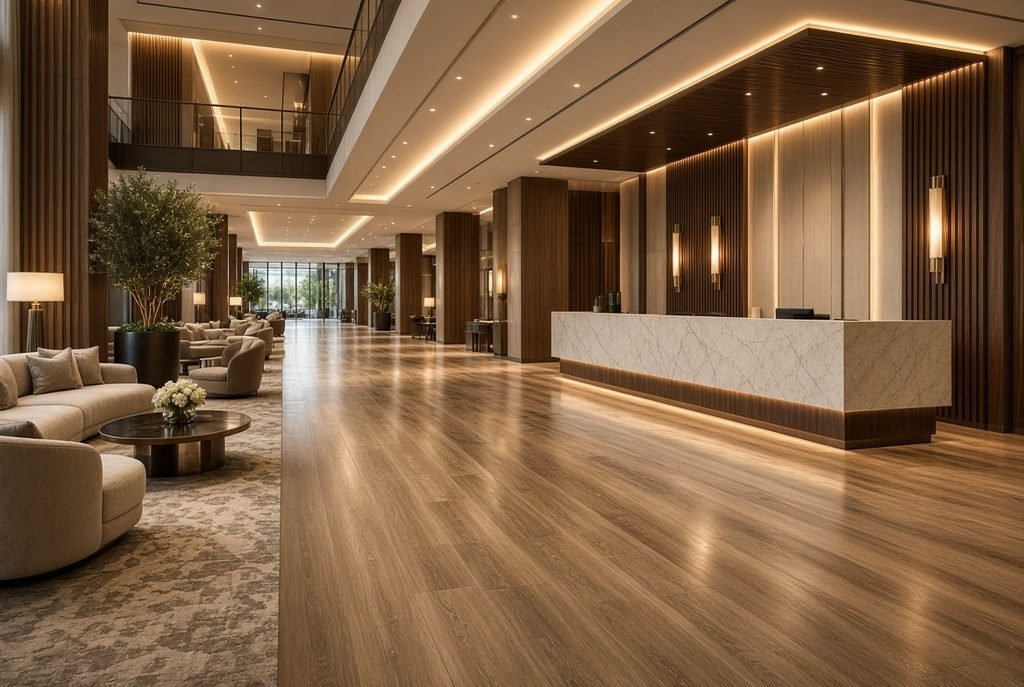
Choosing the right hotel flooring UAE solution is important for creating attractive guest spaces while handling heavy foot traffic, frequent cleaning, humidity, spills, luggage movement, and daily commercial use. Hotels need flooring that looks premium but is also durable, easy to maintain, comfortable, and suitable for the UAE climate.
From hotel rooms and corridors to lobbies, restaurants, reception areas, and service spaces, the best flooring depends on how each area is used. SPC, vinyl, laminate, engineered wood, porcelain tile, and carpet can all work well when selected for the right application.
Hotel flooring refers to flooring materials selected specifically for hospitality properties. Unlike residential flooring, hotel flooring must usually handle much higher traffic and more frequent maintenance.
A good hotel flooring solution should offer:
Hotels also need different flooring materials for different areas. A luxury lobby may require an elegant stone or wood appearance, while guest rooms may benefit from comfortable vinyl, SPC, carpet, or engineered wood.
Hotels in the UAE operate in a demanding environment. High temperatures, humidity, sand, dust, intensive air conditioning, and continuous guest movement can all affect flooring performance.
The flooring used in a hotel should therefore be selected according to the room function rather than appearance alone.
For example:
Understanding these requirements helps hotel owners avoid replacing unsuitable flooring after only a few years.
There is no single flooring material that is perfect for every hotel area. The most effective approach is to select different products according to traffic, moisture, design requirements, and maintenance needs.
SPC flooring is one of the practical options for modern hotel projects in the UAE.
SPC stands for Stone Plastic Composite. It combines a rigid core with decorative layers that can reproduce the appearance of natural wood or stone.
You can explore SPC flooring UAE for applications where durability and moisture resistance are important.
Benefits include:
SPC can be particularly useful for hotel corridors, guest rooms, apartments within hospitality properties, offices, and selected common areas.
Vinyl flooring is another popular choice for hospitality environments.
Modern vinyl flooring can provide realistic wood and stone appearances without requiring the maintenance associated with some natural materials.
Vinyl flooring UAE can be considered for guest rooms, corridors, restaurants, reception areas, and other spaces where practical maintenance is important.
Its main advantages include:
Vinyl can also help hotels create a consistent interior design across multiple rooms.
Laminate flooring can provide a wood appearance at a relatively accessible cost.
It can work well in areas where the hotel wants a warm timber aesthetic without using natural hardwood throughout the property.
However, hotel owners should consider the moisture exposure and traffic level before selecting laminate.
A useful comparison is SPC versus laminate because the two materials have different performance characteristics.
Laminate can be suitable for:
Engineered wood can provide a premium natural appearance for luxury hotels.
It consists of a real wood surface combined with engineered layers underneath. This construction can provide more dimensional stability than traditional solid wood.
Engineered wood can be considered for:
For high end hotel interiors, natural wood can create a sophisticated and warm atmosphere.
Porcelain and ceramic tiles remain practical choices for many hotel areas.
They are especially useful in spaces exposed to moisture or frequent cleaning.
Common applications include:
Large format porcelain tiles can also create a premium stone appearance while providing a practical surface for commercial environments.
Carpet remains relevant in hospitality, particularly where comfort and acoustics are priorities.
Hotels often use carpet in:
Carpet can reduce walking noise and create a softer, more comfortable environment.
However, hotel operators should select commercial grade products that can withstand regular cleaning and heavy use.
The lobby creates the first physical impression of a hotel.
This means flooring needs to balance appearance with durability. Guests may enter with luggage, outdoor dust, sand, and moisture from different weather conditions.
Popular lobby options include:
Large spaces can also combine different flooring materials to define reception, waiting, seating, and circulation areas.
The most important consideration is that the flooring should remain attractive despite constant movement.
Guest rooms require a different approach from hotel lobbies.
Guests expect hotel rooms to feel comfortable, clean, quiet, and visually appealing.
Suitable flooring may include:
Wood look flooring can create a warm and residential atmosphere, while vinyl and SPC can simplify maintenance.
For hotels targeting a luxury aesthetic, engineered wood can provide a genuine natural wood surface.
Hotel corridors experience some of the highest levels of repeated foot traffic.
Guests, staff, luggage carts, housekeeping equipment, and service workers can move through corridors throughout the day.
The flooring should therefore have:
Commercial vinyl, SPC, carpet, and porcelain tile can all be considered depending on the hotel design.
Carpet can be particularly useful when reducing corridor noise is important.
Bathrooms require flooring with strong moisture resistance and appropriate slip performance.
Water can come from showers, sinks, cleaning activities, and guest use.
Hotel bathroom flooring commonly includes:
For additional guidance, see waterproof flooring Dubai for moisture exposed spaces.
The flooring should also be easy for housekeeping teams to clean between guest stays.
Hotel restaurants experience a combination of food spills, constant movement, chairs, tables, cleaning chemicals, and frequent maintenance.
The flooring should therefore prioritize:
Porcelain tile and commercial vinyl are common choices depending on the restaurant concept.
For additional hospitality applications, explore restaurant flooring options.
Commercial hotel kitchens have different requirements from guest areas.
Kitchen flooring must handle:
The surface should be practical, durable, and easy to clean.
Slip resistance is particularly important because water and food materials can create hazardous conditions.
Reception areas combine high traffic with visual presentation.
Guests spend time checking in, waiting, moving luggage, and entering or leaving the property.
The flooring should therefore provide both durability and an attractive first impression.
Large format porcelain, stone appearance, premium vinyl, SPC, and engineered wood can all be incorporated depending on the hotel’s interior design.
Not every hotel space experiences the same amount of traffic.
High traffic zones typically include:
These areas need flooring designed for repeated use.
Choosing residential grade flooring simply because it is cheaper can result in faster wear, visible damage, and higher replacement costs.
For large hospitality projects, product specifications should be checked carefully before installation.
The UAE climate should be considered when selecting hotel flooring.
Heat and humidity can affect certain flooring materials, especially when installation conditions are not properly controlled.
Hotels should consider:
You can also review humidity resistant flooring when comparing flooring options for UAE properties.
Proper installation is just as important as selecting the correct material.
Even high quality commercial flooring requires regular maintenance.
Hotel housekeeping teams should follow manufacturer recommendations rather than using aggressive cleaning chemicals unnecessarily.
A basic maintenance program can include:
For vinyl installations, maintaining vinyl flooring provides useful guidance for long term care.
Hotel owners and project managers should evaluate flooring using several criteria.
Start by identifying how many people use the area every day.
A hotel lobby needs a different performance level from a private guest room.
Bathrooms, kitchens, pool areas, and some restaurants require materials that can tolerate regular moisture.
Choose surfaces that housekeeping teams can clean efficiently.
Easy maintenance can reduce long term operating costs.
Flooring should complement walls, furniture, lighting, doors, and other interior finishes.
Slip resistance and surface stability are important in commercial hospitality environments.
Even an excellent flooring product can perform poorly if the subfloor is not prepared correctly.
Professional installation can help achieve accurate cuts, appropriate expansion gaps, clean transitions, and a better finished appearance.
Hotel owners do not necessarily need to select the cheapest flooring product.
The better strategy is to calculate total value.
A low cost flooring material may require earlier replacement or more maintenance. A slightly higher quality product may provide better durability and a lower long term cost.
For budget planning, the Dubai flooring cost guide can help compare common flooring materials and installation costs.
The final price can depend on:
Correct installation is essential for hotel flooring because commercial properties have little room for repeated installation problems.
Professional installers should assess the subfloor before laying the flooring.
Important installation considerations include:
Hotels can review professional flooring installation when planning a commercial flooring project.
Several mistakes can increase hotel flooring costs.
A beautiful floor is not necessarily suitable for heavy commercial traffic.
Hotel environments generally require products designed for more demanding use.
Uneven or damaged subfloors can affect the final result.
Different hotel areas have different performance requirements.
The flooring should match the hotel’s housekeeping procedures.
The cheapest initial quote may not represent the lowest long term cost.
Incorrect installation can reduce the lifespan of even high quality flooring.
For more renovation guidance, see flooring mistakes to avoid.
| Flooring | Durability | Moisture Resistance | Maintenance | Best Use |
|---|---|---|---|---|
| SPC | High | High | Easy | Rooms and corridors |
| Vinyl | High | High | Easy | Rooms, restaurants and common areas |
| Laminate | Medium to High | Moderate | Easy | Guest rooms and offices |
| Engineered Wood | High | Moderate | Moderate | Luxury rooms and suites |
| Porcelain Tile | Very High | High | Easy | Lobbies, bathrooms and restaurants |
| Carpet | Medium to High | Low | Moderate | Rooms, corridors and lounges |
The right selection depends on the specific hotel area, traffic level, design requirements, and maintenance strategy.
Luxury hotels often require flooring that communicates quality immediately.
Premium materials can be combined rather than using one material throughout the property.
For example:
This approach allows designers to achieve a premium appearance while maintaining practicality.
Budget and mid range hotels have different priorities.
The flooring needs to look attractive while controlling installation and maintenance costs.
SPC, vinyl, laminate, and commercial carpet can provide practical solutions depending on the area.
A mixed flooring strategy can be particularly useful. Higher budget materials can be used in guest facing areas while more economical commercial materials are selected for back of house spaces.
Hotel renovations require careful planning because flooring work can affect operations.
Project managers should consider:
The flooring supplier and installer should coordinate with the hotel’s operating schedule to reduce disruption.
A professional flooring supplier can provide more than flooring products.
A complete service may include:
For a hotel project, having one coordinated flooring partner can make procurement and installation easier.
Urban Floors supplies and installs multiple flooring types across the UAE, including SPC, vinyl, laminate, and engineered wood, with professional installation and project support.
Before selecting flooring, hotel owners and project managers should ask:
Answering these questions makes it easier to compare flooring suppliers accurately.
SPC, vinyl, porcelain tile, engineered wood, laminate, and carpet can all work well in hotels. The best option depends on the area, traffic, moisture exposure, design requirements, and maintenance needs.
Yes. SPC can be suitable for hotel rooms, corridors and selected common areas because it offers a durable rigid structure, water resistance, easy maintenance, and wood look designs.
Hotel corridors need flooring that can handle frequent foot traffic and regular cleaning. Commercial vinyl, SPC, carpet, and porcelain tile can all be considered depending on the hotel’s design and acoustic requirements.
Porcelain and ceramic tiles are commonly suitable for hotel bathrooms because they are durable and moisture resistant. Selected waterproof vinyl products can also work depending on the project requirements.
Yes. Modern vinyl flooring can be a practical hotel flooring solution because it offers attractive designs, easy maintenance, moisture resistance, and suitability for commercial applications.
The total cost depends on the flooring material, product quality, project size, subfloor condition, installation requirements, and additional finishing work. A detailed project quotation is more reliable than using one fixed price per square meter.
Yes. Using different materials according to room function is often more practical. Guest rooms, bathrooms, corridors, lobbies, kitchens, restaurants, and service areas have different performance requirements.
Professional installation helps ensure correct subfloor preparation, accurate fitting, proper transitions, and a cleaner finished result. It can also help reduce premature flooring problems in high traffic hospitality environments.