
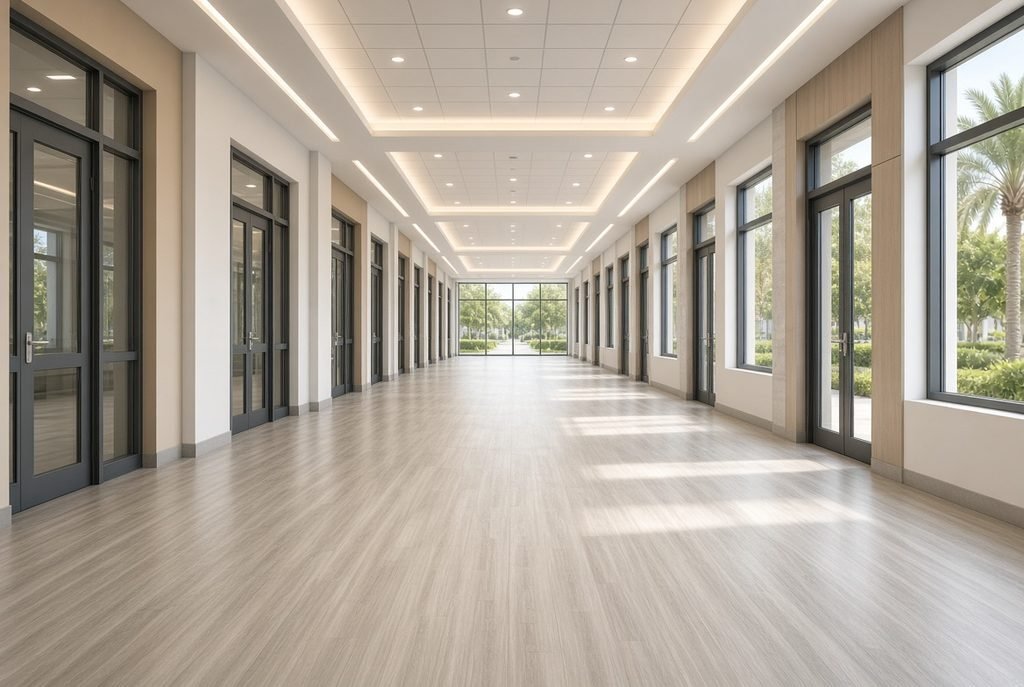
The best school flooring UAE depends on safety, durability, comfort, maintenance, and the type of educational space. Schools need flooring that can handle heavy daily foot traffic, active students, frequent cleaning, spills, furniture movement, and continuous use while creating a comfortable and welcoming learning environment. Vinyl, SPC, rubber, carpet tiles, porcelain tile, and selected laminate flooring can all work well when matched to the right area.
Choosing flooring for a school is different from choosing flooring for a home. Classrooms need comfortable and easy to maintain surfaces, corridors require excellent durability, activity rooms need impact resistance, and wet areas need moisture resistant flooring. The UAE climate also makes temperature, humidity, dust, and maintenance important considerations.
School flooring refers to flooring materials selected specifically for educational environments such as schools, nurseries, colleges, training centres, libraries, laboratories, classrooms, corridors, cafeterias, and activity rooms.
Educational buildings experience much higher daily traffic than most residential properties. Hundreds of students and staff may walk across the same floors every day.
Good school flooring should provide:
The best solution depends on where the flooring will be installed and how the area will be used.
Flooring has a direct effect on the daily school environment.
Students spend several hours each day inside classrooms, corridors, libraries, laboratories, and activity areas. A poor flooring choice can create maintenance problems, safety concerns, or premature replacement costs.
A suitable flooring system can help schools maintain:
Schools also need flooring that looks attractive without requiring excessive maintenance.
There is no single flooring material that is ideal for every part of a school.
Common options include:
The most appropriate option depends on traffic, moisture, noise, comfort, cleaning, and the function of the room.
Vinyl flooring is one of the practical options for educational environments because it combines durability, easy maintenance, and design flexibility.
Modern vinyl flooring is available in many colours, textures, and wood or stone inspired appearances.
It can work well in:
Vinyl can also provide a softer walking experience compared with some hard tile surfaces.
For UAE projects, explore vinyl flooring services to see suitable flooring solutions.
SPC flooring is another option for selected school environments.
Its rigid construction provides stability, while its moisture resistant characteristics can make it practical for areas where spills and regular cleaning are expected.
SPC can be considered for:
It is also available in wood look designs that can create a warm interior without the maintenance requirements of natural timber.
You can explore SPC flooring options for UAE educational projects.
Rubber flooring can be particularly useful in spaces where impact resistance and comfort are important.
It may be suitable for:
Rubber can provide cushioning underfoot and help create a more comfortable environment for active students.
The appropriate rubber flooring specification depends on the expected activity and safety requirements.
Carpet tiles can provide acoustic and comfort benefits in selected educational environments.
They can be useful in:
One advantage of carpet tiles is that individual damaged sections can often be replaced rather than replacing the entire floor.
However, carpet requires appropriate maintenance because dust and stains can accumulate if cleaning is not performed regularly.
Porcelain tile can be a strong option for areas that require a hard, durable, and easy to clean surface.
It can be suitable for:
The tile surface should be selected carefully because highly polished flooring may not be suitable for areas where water or spills are common.
Laminate flooring can be suitable for selected low to medium traffic areas where appearance and budget are important.
It can provide wood inspired designs while generally requiring less maintenance than natural wood.
However, moisture exposure needs to be considered carefully.
Areas that experience frequent spills or wet cleaning may require a more moisture resistant solution.
You can compare materials in this guide to SPC versus laminate.
Classrooms need flooring that is comfortable, durable, easy to clean, and visually appropriate for learning.
Students move desks and chairs regularly, while teachers and staff walk across the same areas throughout the school day.
Good classroom flooring should provide:
Vinyl and SPC can be suitable options depending on the classroom requirements.
For younger children, comfort and impact resistance may become even more important.
School corridors receive extremely high foot traffic.
Students move between classrooms throughout the day, making corridor flooring one of the most heavily used surfaces in a school.
Corridor flooring should therefore focus on:
Vinyl, suitable tiles, and other commercial flooring systems can be considered depending on the school design.
Libraries require a quieter and more comfortable atmosphere than corridors.
Flooring can contribute to the acoustic environment by reducing sound from footsteps and furniture movement.
Potential options include:
The final choice should consider cleaning requirements, student traffic, and the desired appearance.
School cafeterias experience food spills, heavy traffic, frequent cleaning, and constant furniture movement.
The flooring should therefore be:
Porcelain tile, commercial vinyl, and other suitable hard wearing materials can work depending on the environment.
For areas where water exposure is common, consider waterproof flooring options.
Washrooms require flooring with strong moisture resistance and suitable slip resistance.
The flooring should also withstand frequent cleaning.
Porcelain and ceramic tiles are commonly considered for these areas because they can provide durable and easy to clean surfaces.
The grout, joints, drainage, and installation quality are also important.
A water resistant surface alone does not guarantee a completely moisture safe installation.
Sports areas have different flooring requirements from standard classrooms.
Students may run, jump, change direction, and participate in high impact activities.
The floor should therefore provide:
Rubber and specialized sports flooring systems may be suitable depending on the activity.
Safety should be one of the highest priorities when selecting school flooring.
Children may run through corridors, classrooms, activity areas, and playground access points.
A suitable flooring surface can help reduce risks associated with:
The flooring should also be installed correctly so that transitions between different materials do not create unnecessary trip hazards.
Slip resistance becomes particularly important in areas where water or spills are possible.
These areas may include:
The surface should provide suitable traction without becoming unnecessarily difficult to clean.
The right balance depends on the specific school environment.
Noise is an important consideration in educational buildings.
Hard surfaces can sometimes increase the sound created by footsteps, chairs, tables, and student movement.
In classrooms and libraries, flooring with acoustic benefits can help create a calmer environment.
Carpet tiles and certain resilient flooring systems may provide acoustic advantages depending on the complete floor assembly.
Schools should consider flooring as part of their wider acoustic design rather than treating it as an isolated material choice.
Schools need flooring that can be cleaned efficiently.
Daily student activity can bring dust, sand, food, mud, and other contaminants into the building.
A practical maintenance routine may include:
Easy maintenance can reduce operational effort and help keep school interiors looking professional.
For vinyl installations, see this guide to maintaining vinyl flooring.
The UAE climate means humidity and moisture should be considered during flooring selection.
Humidity itself is not necessarily the main problem. Moisture entering the subfloor or remaining beneath an incorrectly installed floor can create serious issues.
Potential problems include:
Moisture resistant materials can help, but proper subfloor preparation remains essential.
You can also read about UAE humidity resistant flooring for more information.
Dust and sand are unavoidable considerations in the UAE.
Students, staff, and visitors can carry fine particles into schools from outdoor areas.
Over time, abrasive particles can contribute to surface wear.
This makes regular cleaning important.
Flooring with smooth, easy to maintain surfaces can help schools manage daily dust more efficiently.
Entrance areas may also benefit from appropriate mats or cleaning zones to reduce the amount of dirt entering classrooms.
The reception area creates the first impression for parents, students, visitors, and staff.
The flooring should therefore combine:
SPC, vinyl, porcelain tile, and selected engineered wood options can provide attractive results depending on the school design.
Administrative offices generally have lower traffic than corridors and entrances.
This allows schools to consider a wider range of flooring options.
Potential choices include:
The selection should consider office furniture, staff traffic, cleaning requirements, and the overall interior design.
Nurseries require additional attention because young children spend significant amounts of time close to the floor.
Comfort, hygiene, safety, and ease of cleaning become particularly important.
Suitable flooring should ideally be:
Rubber, resilient flooring, vinyl, and selected specialist flooring systems may be considered depending on the space.
Laboratories have specialized requirements because they may involve chemicals, water, equipment, and frequent cleaning.
The flooring should be selected based on the materials used in the laboratory.
Important considerations can include:
The correct specification should be confirmed according to the laboratory function rather than using a general school flooring product.
Outdoor school areas experience sunlight, heat, dust, sand, and changing weather conditions.
Flooring for outdoor spaces needs to be specifically designed for external use.
Possible areas include:
Outdoor decking can be considered for suitable areas. See these outdoor decking solutions for ideas.
Professional installation is important because schools operate on strict schedules.
Flooring work may need to be completed during:
A professional installation process can include:
Proper planning can reduce disruption to school operations.
For more information, explore professional flooring installation.
Schools can face unnecessary costs when flooring is selected without considering the actual environment.
An attractive floor may not be suitable for heavy traffic or frequent cleaning.
Schools need flooring that can be maintained efficiently throughout the academic year.
A material suitable for classrooms may not be appropriate for washrooms or cafeterias.
Uneven or damp subfloors can affect the performance of the finished floor.
Different areas have different requirements. A classroom, laboratory, cafeteria, and sports room do not necessarily need the same material.
You can review these flooring mistakes to avoid before starting a school flooring project.
School flooring costs depend on the selected material, floor area, installation method, subfloor condition, and project complexity.
Major cost factors include:
Large school projects may also require phased installation to keep parts of the building operational.
For a broader overview, see the Dubai flooring cost guide.
Start by dividing the school into functional zones.
Prioritize comfort, durability, easy cleaning, and appearance.
Prioritize heavy traffic resistance, cleaning, and durability.
Prioritize stain resistance, moisture resistance, cleaning, and safety.
Prioritize moisture resistance and slip resistance.
Prioritize comfort, quietness, and appearance.
Prioritize impact absorption, traction, and resilience.
Prioritize comfort, appearance, and practical maintenance.
Prioritize appearance, durability, and easy cleaning.
| School Area | Suitable Flooring Priorities |
|---|---|
| Classrooms | Vinyl, SPC, resilient flooring |
| Corridors | Vinyl, durable tile, resilient flooring |
| Libraries | Carpet tiles, vinyl, SPC |
| Cafeterias | Porcelain tile, vinyl |
| Washrooms | Porcelain tile, ceramic tile |
| Sports Areas | Rubber, specialist sports flooring |
| Offices | SPC, vinyl, laminate |
| Reception | SPC, vinyl, tile |
| Laboratories | Specialist chemical resistant flooring |
| Nurseries | Rubber, vinyl, resilient flooring |
The final material should always be selected according to the specific project conditions.
A school flooring project involves more than selecting a colour and material.
Professionals can assess:
This can help schools avoid selecting flooring that looks suitable but performs poorly under daily educational use.
Modern schools are increasingly designed around student comfort, safety, functionality, and attractive interiors.
Flooring contributes to all of these elements.
A well planned school can use different flooring materials to define different zones while maintaining a consistent visual identity.
For example:
This approach creates a practical flooring strategy rather than forcing one material across the entire building.
The best flooring depends on the area and its use. Vinyl and SPC can work well in classrooms and offices, while rubber can suit activity areas and porcelain tile can work well in washrooms and cafeterias.
Yes, vinyl can be a practical school flooring option because it offers durability, easy maintenance, design flexibility, and good performance for many classroom and commercial environments.
SPC can be suitable for classrooms because it offers durability, moisture resistance, and a wide range of modern designs. The specific product should be selected according to traffic and installation requirements.
School corridors need highly durable flooring because they experience constant student and staff traffic. Commercial vinyl, resilient flooring, and suitable tile options can be considered.
Cafeteria flooring should be easy to clean, moisture resistant, stain resistant, and slip resistant. Porcelain tile and suitable commercial vinyl are potential choices depending on the environment.
Rubber flooring can be an excellent option for many school gyms and activity areas because it can provide durability, traction, and impact absorption. The correct specification depends on the type of sports and activities performed.
Porcelain and ceramic tiles are commonly suitable for school washrooms because they can provide durable and easy to clean surfaces. Slip resistance and proper installation are important considerations.
Humidity can become a concern when moisture enters the subfloor or when an unsuitable flooring system is installed. Proper moisture assessment, material selection, and professional installation can help reduce these risks.
The lifespan depends on the material, traffic, installation quality, maintenance, and environmental conditions. High quality commercial flooring can provide many years of service when correctly installed and maintained.
School flooring costs vary based on material, area, installation, subfloor preparation, design, and project requirements. A site assessment is normally required for an accurate quotation.
Not necessarily. Classrooms, corridors, laboratories, cafeterias, washrooms, libraries, and sports areas have different performance requirements, so using different flooring systems can often provide better results.
Professional installation helps ensure proper subfloor preparation, accurate fitting, suitable transitions, and correct finishing. This is particularly important for schools because flooring failures can disrupt daily operations.