
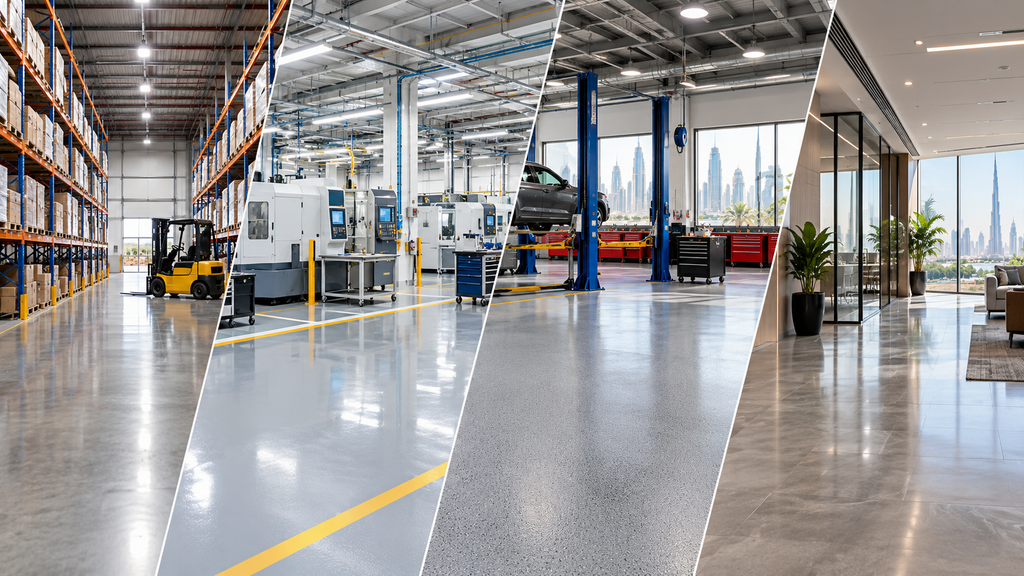
Industrial flooring Dubai needs to handle heavy traffic, machinery, spills, chemicals, heat, dust, and continuous daily use without losing its strength or appearance. The right flooring should provide durability, easy maintenance, slip resistance, moisture protection, and long term performance while matching the practical requirements of warehouses, factories, workshops, garages, showrooms, and commercial facilities.
For most industrial environments in Dubai, the best flooring choice depends on the type of work performed inside the facility. Heavy duty areas may require highly durable resin or concrete based systems, while offices, showrooms, reception areas, and lighter commercial spaces can benefit from SPC, vinyl, or other modern flooring solutions. Proper subfloor preparation and professional installation are equally important because even high quality flooring can fail when installed over an unsuitable surface.
Industrial flooring refers to flooring systems designed for environments where ordinary residential flooring may not withstand daily demands. These spaces can experience heavy foot traffic, equipment movement, rolling loads, spills, moisture, dust, temperature changes, and frequent cleaning.
Unlike standard home flooring, industrial flooring is selected primarily for performance.
Common industrial flooring requirements include:
The ideal flooring system depends on the industry, floor condition, expected traffic, and type of equipment used.
Dubai presents several environmental challenges for industrial facilities. High temperatures, humidity, dust, sand, and intensive air conditioning can all influence the performance of flooring materials.
Industrial facilities also need flooring that can withstand demanding working conditions.
A warehouse may have forklifts moving throughout the day. A workshop may deal with oil and mechanical fluids. A food facility may require frequent washing. A showroom may need a professional appearance while handling constant customer traffic.
This is why choosing flooring based only on appearance can create problems later.
A suitable industrial flooring system should balance:
You can also explore how different materials perform against the local environment in this guide to humidity resistant flooring.
There is no single flooring material that is perfect for every industrial facility. Different areas require different performance characteristics.
The most common options include:
The right choice depends on how the space is used.
Epoxy flooring is widely associated with industrial environments because it can create a hard, seamless surface over a properly prepared concrete base.
It can be suitable for areas exposed to heavy traffic, equipment, spills, and frequent cleaning.
Potential advantages include:
However, epoxy performance depends heavily on surface preparation, moisture conditions, product specification, and installation quality.
A poorly prepared concrete surface can cause cracking, peeling, bubbling, or adhesion problems.
Polished concrete can be a practical choice for warehouses, industrial buildings, commercial facilities, and large open spaces.
It uses the existing concrete slab as the base and mechanically refines the surface to create a smoother and more durable finish.
Advantages can include:
Polished concrete can also help create a clean industrial appearance without requiring a separate decorative floor covering.
Vinyl flooring can be useful in industrial or commercial areas where comfort, appearance, and easy maintenance are important.
It may be more appropriate for offices, staff areas, reception spaces, retail environments, and lighter industrial areas rather than locations exposed to extreme mechanical loads.
For residential and commercial projects, you can also explore vinyl flooring services to understand available vinyl options.
SPC flooring has become popular because of its rigid construction, moisture resistance, durability, and modern appearance.
It can be suitable for selected industrial offices, commercial areas, staff rooms, showrooms, reception spaces, and other areas where a decorative floor is required.
SPC is generally not the first choice for every heavy industrial environment. Facilities with forklifts, heavy machinery, extreme impact, or aggressive chemicals may require a more specialized industrial system.
For suitable applications, you can review SPC flooring solutions.
Warehouse flooring must withstand continuous movement, storage systems, pallet trucks, forklifts, and high levels of foot traffic.
The flooring should also be easy to clean because dust, sand, packaging material, and other debris can accumulate quickly.
Important characteristics include:
Concrete, polished concrete, and suitable resin systems are common choices for demanding warehouse environments.
The exact solution should be selected according to the expected load and type of machinery.
Factory flooring requirements vary significantly depending on manufacturing processes.
A light assembly facility may have very different requirements from a metal workshop or chemical processing facility.
Before selecting a floor, consider:
Factories with frequent liquid spills may require a seamless and easy to clean surface. Areas with heavy equipment may require stronger systems designed for mechanical loads.
Workshops can place significant stress on flooring.
Oil, grease, tools, equipment, vehicle movement, and dropped objects can damage unsuitable surfaces.
Workshop flooring should therefore focus on:
The flooring should also provide sufficient traction for workers who may be exposed to oil or water during daily operations.
Garages require flooring that can handle vehicles, tyres, oil, water, dirt, and regular cleaning.
Concrete and resin based flooring systems can be suitable depending on the garage environment.
For areas where appearance is also important, the flooring can be selected to provide a more polished and professional finish.
The best solution depends on whether the garage is used for:
Each application creates different flooring demands.
Not every industrial property needs a traditional industrial appearance.
Automotive showrooms, equipment suppliers, construction suppliers, and large commercial facilities often require flooring that combines durability with visual appeal.
Modern flooring can help create a cleaner customer experience.
For lighter commercial areas, options can include:
For broader commercial applications, this guide to office flooring solutions can provide useful ideas.
Dubai humidity can affect flooring materials when moisture is present beneath or around the flooring system.
The biggest concern is not simply outdoor humidity. Moisture within the concrete slab or subfloor can create serious flooring problems.
Possible issues include:
This is why moisture testing and proper preparation are important before installation.
Materials with good moisture resistance can be beneficial, but no flooring system can compensate for an unsuitable or excessively damp subfloor.
Dubai experiences extremely high outdoor temperatures during summer.
Indoor industrial environments are generally controlled through air conditioning, but loading bays, warehouses, garages, and semi open facilities may experience significant temperature changes.
Flooring should therefore be selected according to the actual conditions of the facility.
Important considerations include:
The flooring specification should always match the environment rather than relying only on general product claims.
Water resistance is particularly important for facilities where floors are regularly washed or exposed to spills.
Food preparation areas, maintenance facilities, workshops, commercial kitchens, and certain warehouses may require flooring that can tolerate frequent moisture.
However, waterproofing is not only about the surface material.
A complete system also depends on:
For areas such as kitchens and wet commercial spaces, see this guide to waterproof flooring options.
Safety should be one of the first considerations when selecting industrial flooring.
A smooth floor may be easy to clean but can become dangerous when exposed to water, oil, or other liquids.
Slip resistance can be especially important in:
The appropriate surface texture depends on the environment.
Too much texture can make cleaning more difficult, while an excessively smooth surface may reduce traction.
The goal is to achieve an appropriate balance between safety and maintenance.
Choosing industrial flooring should begin with the actual working conditions.
Ask the following questions before selecting a material:
Consider whether the area will have:
A warehouse with forklifts needs a different solution from an office inside the same building.
If chemicals, solvents, oils, or industrial fluids are present, the flooring specification should account for them.
Not every flooring material has the same chemical resistance.
If frequent washing or water exposure is expected, moisture resistance becomes a major factor.
Industrial floors often require regular cleaning.
A surface that is easy to clean can reduce maintenance time and improve workplace hygiene.
Some industrial environments are customer facing.
In those cases, the floor needs to provide both performance and a professional appearance.
SPC is durable and moisture resistant, but it should not automatically be considered the best option for every industrial facility.
Its suitability depends on the level of traffic and the type of work performed.
For offices, reception areas, showrooms, staff spaces, and lighter commercial environments, SPC can offer an attractive combination of durability and design flexibility.
For extremely demanding areas, specialized concrete or resin systems may be more appropriate.
You can compare materials further in this guide to SPC versus laminate.
Even the strongest industrial flooring requires proper maintenance.
Regular cleaning helps prevent dirt and abrasive particles from damaging the surface.
A practical maintenance routine can include:
Maintenance requirements vary according to the flooring material.
For example, vinyl flooring may require different cleaning methods from polished concrete or resin flooring.
Choosing the wrong flooring can create unnecessary repair and replacement costs.
Some common mistakes include:
The cheapest material may not be the cheapest solution over its full service life.
Frequent repairs, replacement, downtime, and maintenance can increase the total cost.
The subfloor is one of the most important parts of a successful installation.
Uneven, damp, contaminated, or damaged concrete can compromise the final floor.
A material designed for homes may not withstand forklifts, machinery, industrial chemicals, or heavy impact.
Safety should always be considered where water, oil, or other liquids may reach the floor.
Even premium flooring can perform badly when installation is rushed or the preparation is inadequate.
Before starting a renovation, review these flooring mistakes to avoid.
Professional installation is particularly important for industrial environments because flooring failures can interrupt operations.
A professional installation process may include:
The exact process depends on the selected flooring system.
Proper preparation is often just as important as the flooring material itself.
You can learn more about professional flooring installation for UAE projects.
Industrial flooring costs vary considerably depending on the material, area size, subfloor condition, installation requirements, and project specifications.
Factors that influence the final cost include:
A basic floor covering may have a lower initial cost, while a specialized industrial system may require a higher investment because of its performance characteristics.
For general Dubai flooring pricing information, see the Dubai flooring cost guide.
The best industrial flooring is not necessarily the most expensive option.
A better approach is to select flooring based on the expected working conditions and total ownership cost.
Consider:
A durable floor that lasts longer and requires less maintenance can provide better value than a cheaper floor that needs frequent repairs.
Industrial flooring can be adapted to many business environments.
Prioritize load resistance, durability, traction, and easy cleaning.
Prioritize chemical resistance, impact resistance, safety, and durability.
Prioritize oil resistance, impact resistance, cleaning, and slip resistance.
Prioritize vehicle loads, fluid resistance, cleaning, and durability.
Balance appearance, durability, cleaning, and customer experience.
Consider SPC, vinyl, carpet tiles, or other commercial flooring according to traffic and design requirements.
Focus on moisture resistance, hygiene, cleaning, and slip resistance.
Industrial flooring is designed around performance requirements rather than purely decorative considerations.
Residential flooring usually focuses on:
Industrial flooring often needs to handle:
This difference is why choosing a residential flooring product for an industrial environment can result in premature damage.
The lifespan of industrial flooring depends on the material, installation quality, traffic levels, maintenance, and environmental conditions.
A floor exposed to heavy machinery will naturally experience more stress than a low traffic office.
Factors affecting lifespan include:
Regular inspection can help identify small problems before they become major repairs.
High traffic areas require surfaces that can tolerate continuous movement.
This may include warehouse aisles, entrances, loading zones, corridors, retail spaces, and production areas.
The flooring should be selected based on the type of traffic rather than simply the number of people using the space.
For example, forklift traffic creates completely different stresses from pedestrian traffic.
Many industrial buildings contain offices, meeting rooms, reception areas, and staff spaces.
These areas do not necessarily require heavy industrial flooring.
Instead, the flooring can be selected to create a comfortable and professional environment.
Suitable options may include:
The right choice depends on the desired appearance, traffic level, cleaning requirements, and budget.
For natural wood appearance, you can explore engineered wood flooring.
Flooring plays an important role in workplace safety.
A suitable floor can help reduce risks associated with:
Floor markings and safety zones can also be incorporated into some industrial environments where required.
The flooring specification should be considered as part of the wider workplace safety strategy.
Businesses are increasingly considering the environmental impact of building materials.
When choosing industrial flooring, consider:
A durable flooring system that lasts for many years can reduce the need for frequent replacement.
Modern industrial facilities are increasingly designed to combine operational efficiency with professional appearance.
Warehouses may include customer facing areas. Manufacturing companies may have modern reception spaces. Automotive businesses may use showrooms alongside workshops.
This creates a need for flooring that performs well while maintaining a clean visual identity.
Using different flooring systems in different zones can be an effective approach.
For example:
This approach allows each space to use flooring suited to its specific requirements.
Before choosing industrial flooring Dubai, review the following checklist:
Answering these questions can make the flooring selection process much easier.
The best industrial flooring depends on the application. Heavy duty areas may require epoxy, resin, polished concrete, or specialized concrete systems, while offices and lighter commercial areas may benefit from SPC or vinyl.
Yes, epoxy can be suitable for many industrial environments because it can provide a durable, seamless, and easy to clean surface. Its performance depends on the product specification, concrete condition, moisture level, and installation quality.
Warehouses generally require flooring that can withstand heavy traffic, rolling loads, equipment, and frequent cleaning. Concrete, polished concrete, and suitable industrial resin systems are common choices depending on the warehouse requirements.
SPC can be suitable for selected industrial offices, showrooms, reception areas, and lighter commercial spaces. It may not be appropriate for areas exposed to extreme machinery loads, forklifts, or aggressive industrial chemicals.
Some industrial flooring systems provide strong water resistance, while others require additional protection or sealing. Waterproof performance depends on the material, installation, joints, subfloor, and environmental conditions.
Humidity alone does not necessarily damage a properly selected and installed industrial floor. Problems can occur when moisture enters the subfloor, when unsuitable materials are used, or when installation conditions are not properly controlled.
Industrial flooring costs vary according to material, floor size, surface preparation, installation complexity, thickness, finish, and project requirements. A site assessment is usually needed to determine an accurate project cost.
Industrial flooring lifespan depends on material quality, installation, traffic, machinery, chemicals, moisture, cleaning, and maintenance. A properly specified and maintained system can provide many years of service.
Yes. Garages can benefit from durable flooring systems designed to handle vehicles, oil, water, dirt, and regular cleaning. The correct system depends on whether the garage is for parking, servicing, repairs, or detailing.
Check the existing subfloor, moisture conditions, traffic levels, expected loads, chemical exposure, drainage, cleaning requirements, and slip resistance. Professional assessment can help identify the most suitable flooring system before installation.