
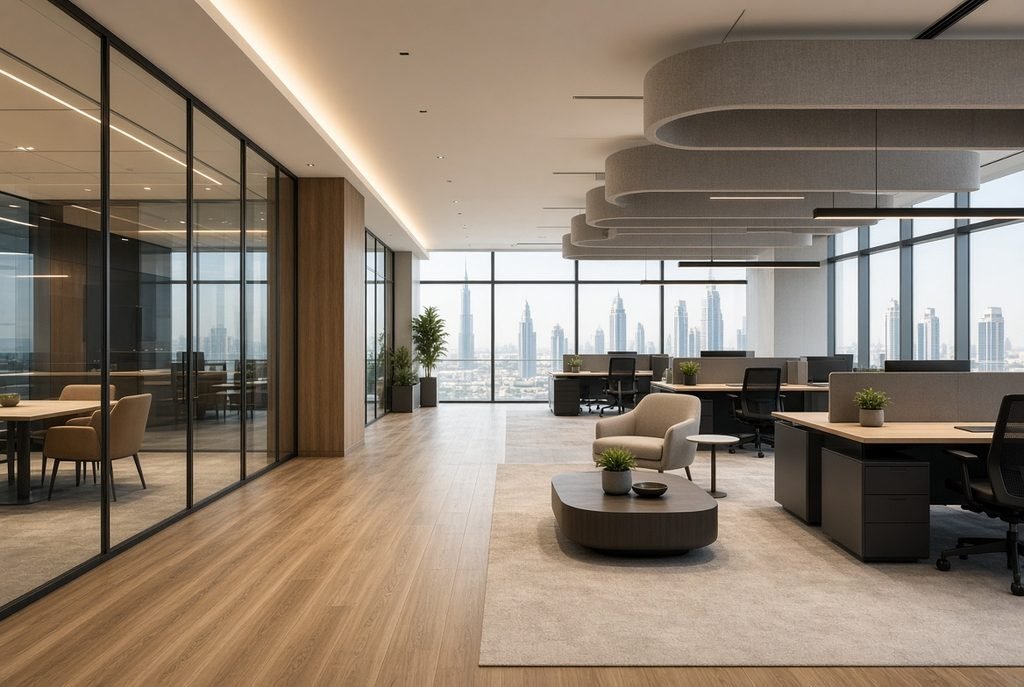
Sound absorbing flooring in the UAE can help reduce footstep noise, impact sounds, echo, and everyday disturbance in homes, offices, schools, hotels, healthcare facilities, and commercial spaces. The best choice depends on the type of noise, the room, expected foot traffic, and the complete flooring system. Vinyl flooring, flooring with acoustic underlay, engineered wood, and selected SPC systems can all contribute to a quieter and more comfortable indoor environment when properly specified and installed.
Sound absorbing flooring is flooring designed to help reduce the amount of sound reflected or generated when people walk across a surface, furniture is moved, or objects come into contact with the floor.
Traditional hard surfaces can reflect sound throughout a room. This can make conversations, footsteps, chair movement, and other everyday sounds more noticeable.
A suitable acoustic flooring system can create a softer and quieter environment.
Sound absorbing flooring can be particularly useful in:
The goal is not simply to make a floor look attractive. The flooring should also support the acoustic requirements of the space.
The UAE has many modern properties with open layouts, large rooms, glass surfaces, tiled areas, and minimal soft furnishings. These design features can increase sound reflection.
In offices, excessive noise can make it harder for employees to concentrate or participate in calls. In apartments and hotels, footstep noise can affect comfort. In schools and healthcare environments, controlling unnecessary noise can create a more suitable atmosphere.
The right flooring can contribute to acoustic comfort while also providing durability and easy maintenance.
However, flooring should be viewed as one part of an overall acoustic strategy.
The acoustic performance of a floor depends on several factors rather than the surface material alone.
These include:
A softer floor can reduce some everyday impact sounds within a room. An acoustic underlay can further improve impact sound performance for compatible flooring systems.
This is why choosing flooring based only on appearance or price may not provide the acoustic result you expect.
Sound absorption and soundproofing are often used interchangeably, but they describe different things.
Sound absorption reduces sound reflection within a room. Flooring, furniture, curtains, acoustic panels, and other soft surfaces can all contribute.
Impact sound refers to noise created when something physically contacts the floor.
Examples include:
A suitable flooring system can help reduce some of this impact noise.
Soundproofing is concerned with limiting sound transmission from one space to another.
If the problem is severe noise transmission between apartments or floors, changing the flooring alone may not solve the issue. The floor structure, walls, ceiling, doors, and acoustic insulation may also need attention.
Different flooring materials provide different levels of acoustic comfort.
The best option depends on the property and how the space will be used.
Vinyl is one of the most practical flooring choices when acoustic comfort, durability, moisture resistance, and easy maintenance are all important.
Its softer construction can provide a quieter and more comfortable experience underfoot compared with many rigid flooring surfaces.
For UAE homes and commercial spaces, modern vinyl products are available in realistic wood and stone designs.
If acoustic comfort is one of your main priorities, exploring suitable vinyl flooring UAE options can help you compare available flooring systems.
SPC flooring is known for its rigid stone composite core, durability, water resistance, and dimensional stability.
However, standard SPC is not automatically an acoustic flooring solution.
Its acoustic performance can improve when the product includes suitable acoustic backing or when a compatible acoustic underlay is used.
The correct system depends on the product manufacturer’s specifications.
SPC can be a good choice when durability is a priority and acoustic performance can be addressed through the complete installation system.
For residential and commercial projects, you can compare different SPC flooring UAE options according to the requirements of the space.
Laminate flooring can provide the appearance of natural wood while offering a practical surface for residential and commercial interiors.
Because laminate has a relatively rigid construction, the acoustic performance can depend heavily on the underlay and installation method.
A compatible acoustic underlay can help improve impact sound performance and walking comfort.
Laminate can work well in:
The correct underlay should always be selected according to the flooring manufacturer’s requirements.
Engineered wood provides a natural premium appearance and can contribute to a warmer and more comfortable interior environment.
Its acoustic performance depends on its construction, thickness, subfloor, underlay, and installation method.
It can be suitable for:
When selecting wood flooring, acoustic requirements should be considered together with humidity, temperature, maintenance, and long term durability.
Apartment residents can be particularly sensitive to impact noise.
Common sources include:
The right flooring system can help create a quieter environment, particularly when combined with a suitable acoustic underlay.
Vinyl is a strong choice when comfort and quieter walking are priorities.
Engineered wood can work well in premium interiors when combined with the appropriate installation system.
Laminate can also be considered with a suitable acoustic underlay.
However, if the problem involves serious noise transmission between floors, the building structure must also be evaluated.
Bedrooms should provide a comfortable and peaceful environment.
Hard surfaces can sometimes make small sounds more noticeable because sound reflects from floors, walls, and ceilings.
Vinyl can provide a quieter and softer walking experience while also being easy to maintain.
Engineered wood can provide a premium appearance and comfortable feel.
Laminate can also be suitable when the correct acoustic underlay is selected.
A combination of flooring and other soft interior elements can provide better overall acoustic comfort than flooring alone.
Office environments can benefit significantly from acoustic flooring.
Open plan workplaces often contain hard desks, glass partitions, large walls, and other surfaces that can reflect sound.
Footsteps and chair movement can become distracting when many employees share the same workspace.
For this reason, acoustic performance should be considered when selecting office flooring.
You can explore suitable office flooring solutions when planning an office environment that needs to balance durability, appearance, and acoustic comfort.
Vinyl can be particularly useful in open plan spaces because of its comfortable walking characteristics.
Meeting rooms require an environment where conversations can be heard clearly without excessive background noise.
Flooring is only one part of the acoustic design.
A suitable flooring system can be combined with:
Vinyl, laminate with acoustic underlay, or engineered wood can all be considered depending on the design and performance requirements.
The best solution should balance acoustic comfort with the professional appearance expected in a business environment.
Schools experience constant movement throughout the day.
Students walk between classrooms, move chairs, use corridors, and participate in activities.
This can create significant background noise.
Flooring for educational facilities therefore needs to balance acoustic comfort with:
Classrooms and libraries can particularly benefit from flooring systems that reduce unnecessary footstep noise.
Corridors require a more durable solution because they receive constant traffic throughout the school day.
Hotels need to create comfortable environments where guests can rest without unnecessary noise.
Flooring can contribute to acoustic comfort in:
Guest room flooring should be selected with both comfort and acoustic performance in mind.
Corridors may require a more durable commercial solution because of constant luggage movement and foot traffic.
For premium interiors, engineered wood or high quality vinyl can provide an attractive balance between appearance and practicality
Healthcare environments require careful flooring selection.
Patients and staff may be affected by:
Flooring should therefore be evaluated for acoustic comfort as well as hygiene, maintenance, durability, and safety.
The correct material depends on the area.
Patient rooms, corridors, waiting areas, consultation rooms, and treatment areas may each have different flooring requirements.
Acoustic performance should be considered as part of the complete healthcare interior rather than as a standalone flooring feature.
Restaurants can become noisy because of conversations, chairs, tables, kitchen activity, and constant customer movement.
Hard flooring surfaces can sometimes increase sound reflection.
A flooring system with better acoustic characteristics can contribute to a more comfortable dining environment.
However, restaurants also need flooring that is:
For broader flooring considerations, you can review suitable restaurant flooring options for commercial dining environments.
Acoustic underlay can play an important role in the performance of certain floating flooring systems.
Depending on the flooring and product specifications, suitable underlay can help:
However, an underlay should not be selected randomly.
Some flooring products have integrated backing and may not require additional underlay. In some cases, using an unsuitable underlay can interfere with product performance or manufacturer requirements.
Always check the flooring specification before installation.
When acoustic comfort is the main priority, vinyl and SPC should not be treated as identical flooring systems.
Vinyl generally provides a softer and quieter walking experience.
SPC provides greater rigidity, stability, and resistance to everyday wear.
| Feature | Vinyl | SPC |
|---|---|---|
| Acoustic comfort | Excellent | Good with suitable backing |
| Underfoot comfort | Excellent | Good |
| Water resistance | Excellent | Excellent |
| Stability | Good | Excellent |
| Heavy traffic | Excellent | Excellent |
| Maintenance | Easy | Easy |
| Design options | Wide | Wide |
| Residential use | Excellent | Excellent |
| Commercial use | Excellent | Excellent |
For bedrooms, apartments, and offices where acoustic comfort is particularly important, vinyl may be the stronger option.
For areas where dimensional stability and heavy traffic performance are more important, SPC may be preferable.
Choosing the correct flooring requires more than looking at product samples.
First determine what type of noise is causing the problem.
Is it:
Different problems require different solutions.
A bedroom has different requirements from a busy office.
A hotel corridor has different requirements from a private apartment.
The flooring should match the environment.
Do not evaluate the surface material alone.
Consider:
Commercial flooring needs to withstand frequent cleaning and heavy traffic.
Residential flooring may place greater emphasis on comfort and appearance.
In kitchens, bathrooms, entrances, and other moisture exposed areas, moisture resistance becomes particularly important.
Flooring is only one component of acoustic comfort.
A room with hard floors, glass walls, bare ceilings, and minimal furniture can still have significant echo even after installing a quieter flooring product.
For better acoustic results, consider combining flooring with:
The best result usually comes from treating several sound reflecting surfaces rather than relying on flooring alone.
Correct installation is important for achieving consistent flooring performance.
Installation should begin with an inspection of the existing floor.
The subfloor should be checked for:
The surface may require cleaning, leveling, repair, or moisture treatment before installation.
If acoustic underlay is required, it should be compatible with the flooring system.
Flooring should be installed according to the manufacturer’s requirements.
Edges, transitions, skirting, and expansion areas should be finished correctly.
Professional installation can help prevent movement, gaps, uneven areas, and other problems.
For installation requirements, you can explore professional flooring installation services across the UAE.
A beautiful floor may not provide the acoustic performance required for the room.
Vinyl can provide good acoustic comfort, but products differ in construction and performance.
Not every underlay works with every flooring system.
An uneven or poorly prepared subfloor can affect both comfort and flooring performance.
Flooring can help reduce certain sounds but cannot solve every structural noise problem.
The lowest initial price may not provide the best long term performance.
Even good flooring can perform poorly if installed incorrectly.
Proper maintenance helps preserve both the appearance and performance of flooring.
Remove dust and dirt regularly.
Cleaning products should be compatible with the flooring material.
Furniture pads can help reduce noise from moving chairs and tables while also protecting the floor.
Prompt cleaning can prevent stains and surface damage.
Regular inspections can identify loose areas, damaged joints, or other problems early.
For vinyl installations, proper cleaning and care are particularly important for maintaining the floor over time. You can also review guidance on how to maintain vinyl flooring in the UAE climate.
The cost depends on the flooring material, room size, installation system, subfloor condition, underlay, and project requirements.
Additional costs may include:
A cheaper flooring surface may become more expensive if it requires additional preparation or specialized installation.
For a better understanding of flooring project costs, you can review this Dubai flooring cost guide.
| Application | Recommended Flooring |
|---|---|
| Apartment | Vinyl with suitable acoustic system |
| Bedroom | Vinyl or engineered wood |
| Living room | Vinyl, laminate, or engineered wood |
| Open plan office | Vinyl |
| Meeting room | Vinyl or laminate with acoustic underlay |
| Hotel room | Vinyl or engineered wood |
| School classroom | Commercial acoustic flooring system |
| Library | Quiet vinyl or suitable acoustic flooring |
| Healthcare facility | Commercial flooring selected for acoustic and hygiene needs |
| Reception | Vinyl, laminate, or engineered wood |
| High traffic area | Commercial vinyl or SPC |
Sound absorbing flooring is not simply about choosing the softest material available.
A professional flooring assessment can consider:
This approach helps ensure that the flooring performs properly while also meeting the practical requirements of the property.
Urban Floors offers flooring solutions across the UAE, including SPC, vinyl, laminate, and engineered wood, with professional installation and project guidance.
Vinyl is one of the strongest practical options for acoustic comfort because it provides a softer and quieter walking experience than many rigid flooring surfaces. The final result depends on the complete flooring system and installation.
Yes. Vinyl can reduce everyday footstep noise and provide a quieter walking experience. Its acoustic performance depends on its construction, backing, subfloor, and installation method.
SPC can provide reasonable acoustic performance, particularly when it includes suitable acoustic backing. However, its rigid construction generally makes it less acoustically soft than vinyl.
Vinyl is a strong option for apartments where footstep noise and comfort are important. Engineered wood and laminate with suitable acoustic underlay can also be considered.
A compatible acoustic underlay can help reduce impact noise in suitable flooring systems. The actual improvement depends on the flooring, underlay, subfloor, and installation construction.
No. Flooring can help reduce certain types of sound, particularly footstep and impact noise, but complete soundproofing requires consideration of walls, ceilings, doors, insulation, and building structure.
Vinyl is a strong option for offices because it provides a comfortable and relatively quiet walking experience while also offering durability and easy maintenance.
Laminate can provide good acoustic comfort when installed with a suitable acoustic underlay. The underlay and complete installation system can have a significant effect on the final result.
Yes. Engineered wood can provide a premium appearance and comfortable underfoot experience. Its acoustic performance depends on the construction, underlay, subfloor, and installation method.
The cost varies according to flooring type, room size, acoustic underlay, subfloor preparation, installation method, and finishing requirements. A detailed quotation is recommended for an accurate project budget.
The best sound absorbing flooring UAE solution depends on the type of noise, the room, the flooring material, the subfloor, and the complete installation system. Vinyl is often a strong choice when quiet walking, comfort, moisture resistance, and easy maintenance are priorities. SPC, laminate, and engineered wood can also work well when paired with the right acoustic system.
For the best result, consider flooring as part of the overall acoustic design rather than expecting the floor alone to eliminate every source of noise.